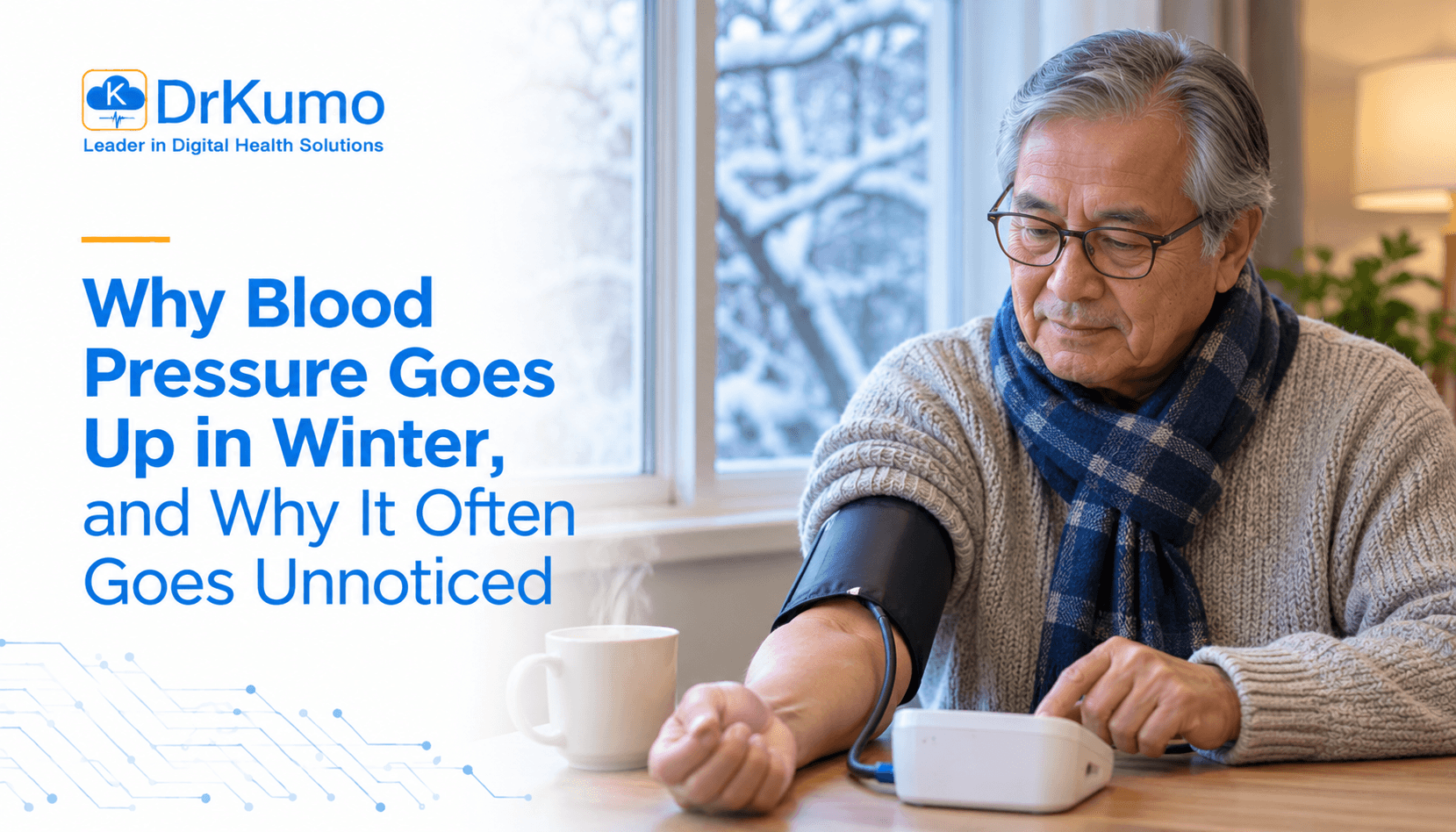
If your blood pressure reads a little higher in January than it did in July, you are not imagining it. Cold months push blood pressure up for most adults, and researchers have measured this pattern for decades.
The short answer Yes, blood pressure really does rise in winter. On average, readings run about 6 points higher on the top number in cold months than in warm ones. Cold is the main reason. Your body narrows the blood vessels near your skin to keep heat in, and that pushes pressure up. It is easy to miss. There are no symptoms, and if your checkups fall in autumn and spring, nobody measures you during the months when your numbers run highest. |
Below is what the research shows, in everyday terms, and a few questions worth bringing to your next appointment.
6 points higher, on average, in cold months than warm ones | 8 points higher on winter mornings in homes kept about 18°F colder | 60,676 U.S. adults in a study that saw winter readings creep up |
Does Blood Pressure Really Go Up in Winter
Yes. It is one of the steadiest patterns in blood pressure research.
Scientists have found it in clinics, in people’s homes, and with devices worn for a full day. They have found it in many countries and many climates.
A blood pressure reading has two numbers, like 128/78. The top number is the pressure while your heart beats. The bottom number is the pressure between beats. Both tend to rise in winter, and the top number moves more.
How Much Higher Does It Go
About 6 points on the top number and 3 points on the bottom, on average.
That figure comes from researchers writing in the American Journal of Hypertension, who pooled the results of 47 separate studies.
They also made a comparison worth remembering: that seasonal change is about as big as the drop a blood pressure medication might produce, especially in older adults. It is not a rounding error.
Two groups saw bigger swings than everyone else: older adults, and people already being treated for high blood pressure.
A separate U.S. study of 60,676 adults being treated for high blood pressure found a smaller winter rise, around 1.7 points. Those patients lived mostly in the Southeast and Midwest, where winters are milder and homes stay heated. It was presented at an American Heart Association meeting, so it counts as early findings rather than settled science. |
Why Cold Weather Raises Blood Pressure
Your body narrows blood vessels near the skin to hold heat in, and narrower vessels mean higher pressure.
It happens before you even notice you are cold.
STEP 1 Nerves in your hands, feet, and face sense the cold. | STEP 2 Your brain tells blood vessels near the skin to tighten. | STEP 3 Warm blood stays in your core, where it matters most. | STEP 4 The same blood squeezing through tighter vessels reads as higher pressure. |
This is a normal, protective response. It simply shows up on the cuff.
Winter habits add to it. Most of us move less and eat differently when it is cold. But the body’s reaction to cold appears to do most of the work, because the pattern shows up even when researchers look only at how warm people keep their homes.
Does the Temperature in My House Matter
More than most people expect.
In a Japanese study of 3,775 households, published in the journal Hypertension, morning readings ran about 8 points higher in homes that were roughly 18°F colder.
Cooler rooms went with higher morning numbers, and the link was strongest in older adults. In one trial, turning the heat up led to lower morning readings.
The World Health Organization suggests keeping indoor spaces at 64°F or above. What is right for your home, your health, and your heating bill is a good thing to raise with your doctor.
Who Sees the Biggest Change
Older adults, people already on blood pressure treatment, and anyone living in a cold home.
There is one more pattern worth knowing. Some people have readings that look fine at the clinic but run high at home, and that becomes more common in winter.
It is a tricky situation, because the one number many people trust is the reassuring one.
Why Winter Changes Slip By Unnoticed
Because the coldest months often fall between appointments.
If you are seen every three to six months, a visit in October and the next in April leaves the whole winter unmeasured.
There is also the room itself. A clinic is warm, and you have usually been sitting indoors for a while before the cuff goes on. That reading is real. It just reflects a warm waiting room, not a cold Tuesday morning at home.
Does Checking at Home Help
It helps when someone on your care team sees the numbers. On its own, it does not do much.
What home readings do well They are steadier than one-off clinic readings, and they can show things a visit misses, like numbers that run high first thing in the morning. | What they do not do Measuring by itself has not been shown to lower blood pressure. The improvement shows up when a doctor or nurse sees the readings and acts on them. |
That comes from a 2021 position paper by the European Society of Hypertension, a group that sets measurement standards. The same paper is clear about one point: no one should change their own medication dose based on home readings unless their doctor tells them to.
The paper also describes how readings are usually taken, if your doctor asks you to do it: ideally for seven days, with two readings in the morning and two in the evening, after sitting quietly for five minutes, then averaged together instead of judged one by one. Upper-arm cuffs are preferred over wrist or finger devices.
How Your Doctor Can See Readings Between Visits
Some practices offer a service called Remote Patient Monitoring (RPM), or RPM.
A connected cuff sends your readings from home to your care team, who look at them on a schedule the practice sets. Medicare and many insurers cover it when a practice offers it and you qualify.
It is worth being plain about the limits. RPM does not treat anything and does not lower blood pressure by itself. Nobody is watching you around the clock. It does not replace your regular visits, and it is not for emergencies. If something feels urgent, that is a call for emergency care, not a monitoring program.
What it does offer is timing. Your numbers reach your care team while the season is still going, instead of months later.
What to Ask Your Doctor This Winter
You know your own routine better than any article does. These four questions tend to open a useful conversation.
“Have my readings run higher in past winters? Can we look back at my records?” | “Would it help if I checked at home during the cold months? How would you want me to do it?” |
“Does this practice offer RPM? Would I qualify for it?” | “If my numbers shift over the winter, when would you want to hear from me?” |
Asking about monitoring is not asking to change your treatment. It is asking for better information, and most doctors welcome the question.
Where DrKumo Fits In
DrKumo is a healthcare technology company. It does not provide medical care, make clinical decisions, or interpret anyone’s readings. It builds the secure, HIPAA-compliant technology solutions some practices use to run RPM programs, using medical devices as defined by the FDA.
When a practice uses a technology solution like this, a reading you take at home is saved with its date and time and reaches your care team in an organized form, so a winter pattern can be seen while it is still happening. Every medical decision stays with your own clinician. DrKumo also supports provider-led Disease Management Protocols, and its technology solutions are used by practices in rural communities, Federally Qualified Health Centers, and Rural Health Clinics, where getting to a winter appointment is not always simple.
Key Takeaways
| 1 | Blood pressure runs higher in cold months, by about 6 points on the top number on average. |
| 2 | Cold tightens the blood vessels near your skin to keep heat in. That is what lifts the number. |
| 3 | A cold house matters. Morning readings ran about 8 points higher in homes roughly 18°F colder. |
| 4 | Checking at home only helps if the readings reach someone who can act on them. |
| 5 | Ask your doctor whether home checks or RPM would suit you. DrKumo provides technology and is not a clinical entity. |
BRING IT UP AT YOUR NEXT VISIT If winter numbers are on your mind, ask your doctor whether checking at home or a RPM program makes sense for you. If you work at a practice thinking about offering one, our team is happy to answer questions.
|
Frequently Asked Questions
Why does blood pressure go up in winter
Cold makes your body tighten the blood vessels near your skin so warm blood stays in your core. The same amount of blood moving through narrower vessels reads as higher pressure. Moving less and eating differently in winter can add to it.
How much higher is blood pressure in winter
About 6 points higher on the top number and 3 on the bottom, on average. That comes from researchers in the American Journal of Hypertension who pooled 47 studies. Older adults and people already treated for high blood pressure tend to see bigger swings.
Does a cold house raise blood pressure
A study of 3,775 Japanese households found morning readings about 8 points higher in homes roughly 18°F colder. The World Health Organization suggests keeping indoor spaces at 64°F or above. What suits your home and health is a question for your doctor.
Should I check my blood pressure more often in winter
That is your doctor’s call, since they know your history and your treatment. A simple way to raise it: ask whether your readings have run higher in past winters, and whether checking at home through the cold months would be useful for you.
What is RPM
It is a service some practices offer where a connected cuff sends your home readings to your care team, who review them on a set schedule. It does not treat anything, nobody watches you around the clock, and it does not replace regular visits or emergency care. Medicare and many insurers cover it when a practice offers it and you qualify.
References
- Stergiou GS, Palatini P, Kollias A, et al. Seasonal Blood Pressure Variation: A Neglected Confounder in Clinical Hypertension Research and Practice (opens in a new tab). American Journal of Hypertension. 2020;33(7):595-596.
- Kario K. Cold-Induced Hypertension as Life-Environment Disease in Winter: Focus on Data From Japan (opens in a new tab). Hypertension. 2026.
- American Heart Association. Cold weather may pose challenges to treating high blood pressure (opens in a new tab). Research presented at the AHA Hypertension Scientific Sessions 2023 (Barrett RB, et al.).
- Parati G, Stergiou GS, Bilo G, et al. Home blood pressure monitoring: methodology, clinical relevance and practical application: a 2021 position paper (opens in a new tab). Journal of Hypertension. 2021;39(9):1742-1767.
Disclaimer: This article is for information only and is not medical advice. It describes patterns researchers have seen across groups of people, not any one person’s situation. Always talk with a licensed healthcare provider about diagnosis, treatment, medication, or any change to your care plan, and do not change a prescribed medication on your own. If you think you are having a medical emergency, seek immediate medical attention. DrKumo is a healthcare technology provider and is not a clinical entity, and RPM supports monitoring only and does not replace in-person or emergency care. References to the Food and Drug Administration (FDA) do not constitute or imply an endorsement by the FDA or the U.S. Government.