
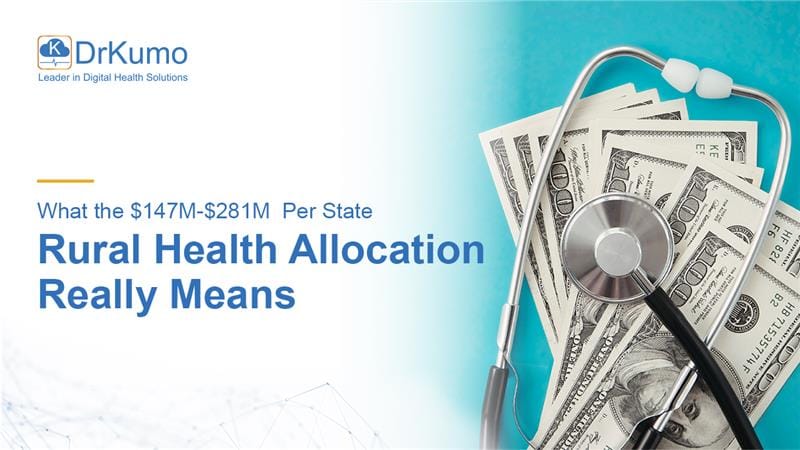
Under a federally authorized rural health transformation initiative administered by the Centers for Medicare & Medicaid Services, each U.S. state is slated to receive between $147 million and $281 million in fiscal year 2026 as part of a targeted rural health allocation to support improvements in healthcare access and service quality. The program commits a total of $50 billion over five years, from 2026 through 2030, and is designed to address long-standing disparities in rural health outcomes through system-level modernization rather than short-term or temporary relief measures.
This funding framework is structured as a performance-driven investment. States are expected to modernize care delivery models, demonstrate measurable improvements in access and outcomes, and address persistent operational constraints common in rural health systems. Federal officials have indicated that continued funding is contingent upon states meeting defined criteria and carrying out proposed initiatives, reinforcing an emphasis on accountability, execution, and sustainability over the full duration of the program.
This article examines what the per-state rural health allocation means in practical terms, how the funding structure influences state-level decision-making, and why scalable, technology-enabled care models are increasingly central to meeting federal expectations for rural health transformation.
Understanding the Structure of the Allocation
The way this rural health funding is structured will significantly influence how states plan, prioritize, and execute their healthcare initiatives over the next five years.
A Five-Year Funding Framework
The program commits $50 billion across fiscal years 2026 through 2030, equating to $10 billion per year distributed across all 50 states. While the headline figures emphasize the per-state allocation range for 2026, the broader structure is equally important:
- Half of the funds are distributed evenly among states.
- The remaining half is tied to state-specific factors, including rural health system needs, policy actions, and the strength of proposed initiatives.
- Federal officials have stated that funds may be recouped if states fail to meet defined criteria or do not carry out pledged actions.
This approach places emphasis on execution, sustainability, and demonstrable improvement rather than one-time spending.
Why This Funding Is Not About Physical Expansion
Federal officials have been explicit that this investment is not intended to finance large-scale construction projects. As noted publicly by CMS leadership, the goal is to “right-size” rural healthcare systems by addressing fundamental barriers to improvement rather than expanding physical footprints.
For many rural regions, workforce shortages, geographic distance, and limited specialty access cannot be solved through new facilities alone. Instead, scalable care models that support continuity, early identification of risk, and coordination across settings are increasingly central to rural health strategies.
The Role of Digital Health in Rural Transformation
While the legislation does not prescribe exact spending categories, digital health capabilities—particularly Remote Patient Monitoring (RPM) and Chronic Care Management (CCM)—are widely recognized as practical tools for rural care delivery. A conservative interpretation of the annual $10 billion allocation suggests that even a modest portion directed toward digital health initiatives represents a substantial national opportunity.
One way to contextualize the scale:
- $50 billion total funding over five years
- $10 billion allocated annually
- An estimated 10% supporting digital health-enabled care models, including RPM and CCM
- Approximately $1 billion per year nationally focused on these capabilities
This framing underscores why states are prioritizing solutions that can be deployed efficiently, integrate with existing systems, and support reporting and outcome measurement.
Accountability and Performance Pressure
A defining feature of this initiative is the explicit linkage between funding and performance. States are expected to demonstrate progress in improving access and care quality for rural populations. This creates a compliance environment in which data integrity, care coordination, and consistent monitoring become operational necessities rather than optional enhancements.
For healthcare organizations and state agencies, the implication is clear: infrastructure choices made in the early years of the program will influence the ability to sustain funding throughout the full five-year period.
How DrKumo Relates to This Shift in Rural Health Strategy
DrKumo’s platform is designed to support care models that align with the priorities embedded in the rural health transformation program. Secure, HIPAA-compliant Remote Patient Monitoring and Chronic Care Management capabilities enable healthcare teams to maintain clinical visibility across geographically dispersed populations while supporting timely, clinically appropriate interventions.
In addition, DrKumo’s underlying infrastructure and architecture—developed to operate at scale in complex healthcare environments—support interoperability, data security, and system reliability. These characteristics are directly relevant to state and regional initiatives that must demonstrate consistency, accountability, and resilience over multiple years.
Preparing for the Next Phase of Rural Health Delivery
As states begin translating federal guidance into actionable programs, technology readiness and operational maturity will play a decisive role. Platforms that support longitudinal care management, standardized protocols, and secure data exchange are better positioned to meet both clinical and administrative requirements tied to this funding.
Takeaways
The $147 – $281 million per-state rural health allocation represents a multi-year, performance-based federal effort to modernize rural healthcare delivery, rather than expand physical infrastructure. Funding is structured to reward states that can demonstrate measurable improvements in access, care coordination, and outcomes, while introducing the possibility of fund recoupment if commitments are not met.
Digital health-enabled care models, including Remote Patient Monitoring and Chronic Care Management, are practical mechanisms for addressing workforce shortages, geographic barriers, and continuity-of-care challenges common in rural settings. As states operationalize this funding, technology readiness, data security, and scalability will be central factors influencing long-term program success.
To learn how DrKumo supports secure, scalable care models aligned with emerging rural health funding requirements, contact us to start the conversation. Our team can help your organization evaluate technology strategies that support accountable, data-driven care delivery.
Disclaimer: This article is intended for informational and educational purposes only and does not constitute legal, regulatory, financial, or medical advice. Funding amounts, allocation assumptions, and program interpretations are based on publicly available information and are subject to change based on federal and state policy decisions. Organizations should consult appropriate legal, regulatory, and healthcare professionals when evaluating participation in government-funded healthcare programs. References to the U.S. Department of Veterans Affairs (VA), the Centers for Medicare & Medicaid Services (CMS), the Food and Drug Administration (FDA), or other U.S. government entities do not constitute or imply an endorsement by the VA, CMS, FDA, or the U.S. Government.