
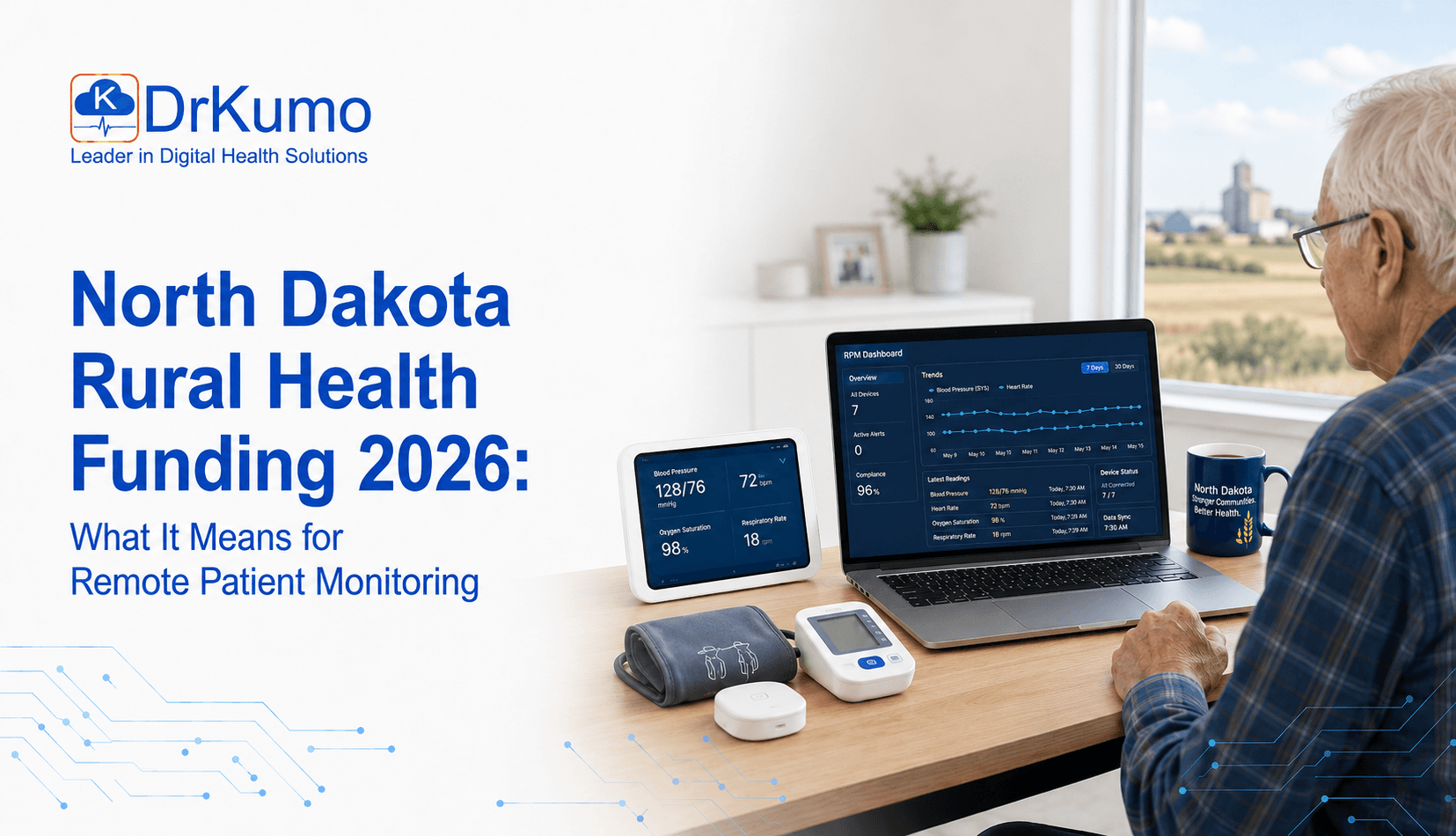
North Dakota has been awarded $199 million for the first year of its Rural Health Transformation Program (RHTP). State lawmakers appropriated the funding during a three-day special session in January 2026. The award is part of a $50 billion national program administered by the Centers for Medicare and Medicaid Services (CMS) to strengthen rural healthcare delivery.
For a state where distance and workforce shortages shape access to care, the investment may influence how services are delivered. That includes expanded use of Remote Patient Monitoring (RPM), which supports providers in reviewing patient data while patients remain at home.
Rural healthcare in North Dakota often requires travel between small communities and regional centers such as Fargo, Grand Forks, or Bismarck. Seasonal weather, transportation limits, and provider shortages add complexity, particularly for older adults managing chronic conditions.
Where the $199 Million Is Going
North Dakota’s approved plan directs the first-year award across four priority areas. The largest share goes to bringing care closer to home.
House Bill (HB) 1623 appropriated $397.9 million in total, covering the first two years of the program. Governor Kelly Armstrong signed the package on January 23, 2026.
| Priority Area | Share of Award | Allocation | Percent |
|---|---|---|---|
| Bringing Care Closer to Home | $116 million | 58% | |
| Connecting Technology, Data, Providers | $33.4 million | 17% | |
| Rural Health Workforce | $32.2 million | 16% | |
| Prevention and Nutrition | $17.1 million | 9% |
The access and technology categories are the two most relevant to remote monitoring. Both cover infrastructure an RPM program depends on.
Expanding Access While Supporting Home-Based Care
Organizations already working in rural North Dakota show the scale at which home-based support operates.
Myrna Hanson, executive director of Community of Care, told WDAY that the organization works with more than 700 patients across 27 rural communities. It runs with four part-time nurses, a social worker, and roughly 45 volunteer drivers.
The program focuses on helping older adults in Cass County remain in their homes for as long as possible.
| Community of Care, at a Glance | |||
|---|---|---|---|
| Patients Served | Rural Communities | Part-Time Nurses | Volunteer Drivers |
| 700+ | 27 | 4 | 45 |
Additional funding may allow similar organizations to cover a larger area, reinforce staffing, and place resources closer to rural residents. Relocation and frequent long-distance travel are not always practical.
Addressing Workforce Shortages Across Regions
Healthcare workforce shortages continue to affect health systems across the state.
Pat Traynor, interim commissioner of North Dakota Health and Human Services (HHS), has said the state commissioned the University of North Dakota’s Center for Rural Health to study staffing gaps. The study covers long-term care facilities, nursing homes, basic care facilities, and other settings, so shortages can be identified region by region.
When provider availability is limited, extending clinician reach becomes a practical priority. Technology-enabled models, including telehealth services and remote monitoring, may support structured oversight without requiring every encounter to occur in person.
The Role of RPM in Rural Communities
Traynor has also pointed to residents of communities such as Cando, Rugby, and Devils Lake connecting with specialists in Fargo, Grand Forks, or Bismarck without leaving home.
RPM supports clinicians in securely reviewing physiologic data such as blood pressure, weight, oxygen saturation, and glucose levels.
Readings transmit from medical devices as defined by the Food and Drug Administration (FDA), including blood pressure monitors, glucometers, pulse oximeters, and weight scales. The care team reviews the data on the schedule the practice establishes.
| What RPM Supports | What RPM Does Not Do |
|---|---|
|
|
RPM is for monitoring purposes only. Patients are not monitored continuously or around the clock, and RPM does not replace in-person clinical evaluation or emergency care.
Infrastructure and Integration Will Shape Outcomes
Funding creates opportunity, but results depend on implementation. Effective RPM programs require reliable connectivity, secure data transmission, documented escalation protocols directed by the practice, and integration into established workflows. Programs also need RPM devices that suit the population being served.
Timing matters as well. A short obligation window favors programs with defined workflows, documented consent, and devices ready to deploy.
The state’s May 2026 grant round included $15 million for rural healthcare safety net services. Allowable uses include purchasing telehealth equipment.
For rural communities, preserving local provider relationships and continuity of care remains essential. Technology should support, not disrupt, community-centered healthcare models.
How DrKumo Supports Structured Rural Monitoring
DrKumo provides secure, Health Insurance Portability and Accountability Act (HIPAA) compliant digital health solutions that support chronic disease management in rural and urban settings. Devices transmit physiologic data over Bluetooth with Wi-Fi or cellular connectivity, so programs can accommodate varying infrastructure conditions. The platform includes evidence-based Disease Management Protocols (DMPs) for hypertension, diabetes, heart failure, and Chronic Obstructive Pulmonary Disease (COPD).
DrKumo is URAC-certified for Telehealth Support Services and one of four providers selected under the U.S. Department of Veterans Affairs (VA) eight-year RPM-Home Telehealth (RPM-HT) contract. It operates under federal healthcare cybersecurity standards, including VA Directive 6500, Federal Information Processing Standards (FIPS) 140-3, and HIPAA. Through its web-based Provider Console, care teams review transmitted data, generate clinical documentation, and maintain structured oversight within established workflows. For organizations evaluating a comprehensive RPM program, DrKumo supports both the device infrastructure and the workflows a program requires.
Key Takeaways
North Dakota’s $199 million first-year award directs $116 million to bringing care closer to home and $33.4 million to technology, data, and providers. Workforce shortages and geographic distance remain the central challenges.
State officials have identified remote patient monitoring as one potential component of improving rural connectivity and specialist access. Its usefulness will depend on connectivity, workforce capacity, and the ability to monitor patients within workflows a rural care team can sustain.
DrKumo is a technology company and is not a clinical entity. DrKumo does not provide clinical services, and providers retain full clinical responsibility for patient care decisions.
Data-Driven Care Starts Here
Build rural monitoring on secure, structured infrastructure.
To learn how DrKumo can support secure, structured remote monitoring for your organization, contact us today. Our team is ready to provide information about our technology solutions.
Frequently Asked Questions
How much rural health funding did North Dakota receive?
▾
CMS awarded North Dakota $199 million for the first year of the RHTP, announced in December 2025. The Legislature appropriated the funds during a special session held January 21 to 23, 2026, and HB 1623 authorized $397.9 million covering the first two years.
Can RHTP funding be used for RPM?
▾
North Dakota allocated $33.4 million to connecting technology, data, and providers, and its May 2026 safety net grant round listed telehealth equipment among allowable purchases. Whether a specific project qualifies depends on the terms of each grant opportunity, so applicants should confirm eligibility with North Dakota HHS.
Does RPM replace in-person care in rural areas?
▾
No. RPM is for monitoring purposes only. Patients are not monitored continuously, and RPM does not replace in-person clinical evaluation or emergency care. It is used to extend provider oversight between visits.
References
North Dakota Health and Human Services. (2025). ND Awarded $199M for Rural Health Transformation Program. HHS.ND.gov.
North Dakota Office of the Governor. (2026). Armstrong Signs Bills Supporting Launch of North Dakota’s Rural Health Transformation Program. Governor.ND.gov.
North Dakota Health and Human Services. (2026). Rural Health Transformation Program Funding. HHS.ND.gov.
North Dakota Monitor. (2026). North Dakota Rural Health Plan Approved. NorthDakotaMonitor.com.
WDAY News. (2026). North Dakota Health Leaders See New Funding as Turning Point for Rural Patients. TheDickinsonPress.com.
University of North Dakota. (2026). Center for Rural Health. RuralHealth.UND.edu.
Disclaimer: This article is intended for informational purposes only and does not constitute medical advice. Always consult with a licensed healthcare provider for guidance on diagnosis, treatment, or medical decisions. Funding amounts, grant terms, and program deadlines are subject to change, and applicants should confirm current requirements with North Dakota Health and Human Services. References to the U.S. Department of Veterans Affairs (VA) and the Food and Drug Administration (FDA) do not constitute or imply an endorsement by the VA, the FDA, or the U.S. Government, and references to federal or state funding programs do not constitute or imply endorsement by any government agency.