Winter is the season people with COPD tend to dread, and for good reason. A cold that would be a nuisance for someone else can turn into the week that lands you in the emergency department.
Plenty of people respond by checking an oxygen reading every morning. That can be useful. It is also widely misunderstood, including the part about what the number cannot tell you.
The scale of it COPD in the United States, per CDC and the National Center for Health Statistics | ||
16 million U.S. adults have COPD, and CDC says many more do not know they have it | 5th Leading cause of death in the United States in 2023 | 141,733 COPD deaths recorded in 2023, per NCHS |
Why Winter Is Harder on COPD
The clearest driver is infection. CDC puts it simply: “Lung infections can cause serious problems for people with COPD.”
The American Lung Association (ALA) names the trigger directly, describing respiratory infections such as a cold, the flu, or a sinus infection as the most common cause of increased COPD symptoms.
The mechanism is not mysterious. A virus inflames airways that are already narrowed, which brings swelling and more mucus, and symptoms get worse from there.
Cold air itself is the other half of the winter story, and here it is worth being careful. Many people with COPD report that cold air makes breathing harder.
But the guidance patients actually receive from CDC, the National Heart, Lung, and Blood Institute (NHLBI), and the ALA puts the emphasis on infection, irritants, and vaccination rather than on the thermometer. This article follows that emphasis.
What a Flare-Up Looks Like
The ALA describes a flare-up, also called an exacerbation, as a sudden worsening of symptoms, with signs that are worse than your normal symptoms, may last two days or more, and do not go away.
| On a normal day, know your own answer | The change the ALA says to notice |
|---|---|
| How breathless am I walking to the kitchen | Shortness of breath worse than your usual level |
| How much do I cough, and what does the mucus look like | More coughing, or changes in color, thickness, or amount |
| How often do I reach for the rescue inhaler | More wheezing or noisy breathing, or needing it more often |
| How well do I sleep, and what is my normal temperature | Difficulty sleeping, or a fever |
The ALA advises knowing how you feel on a normal day, because that is what makes a change recognizable. It also notes that some flare-ups can be managed with medicine and rest, while others are serious and need medical attention.
What a Home Pulse Oximeter Can Show
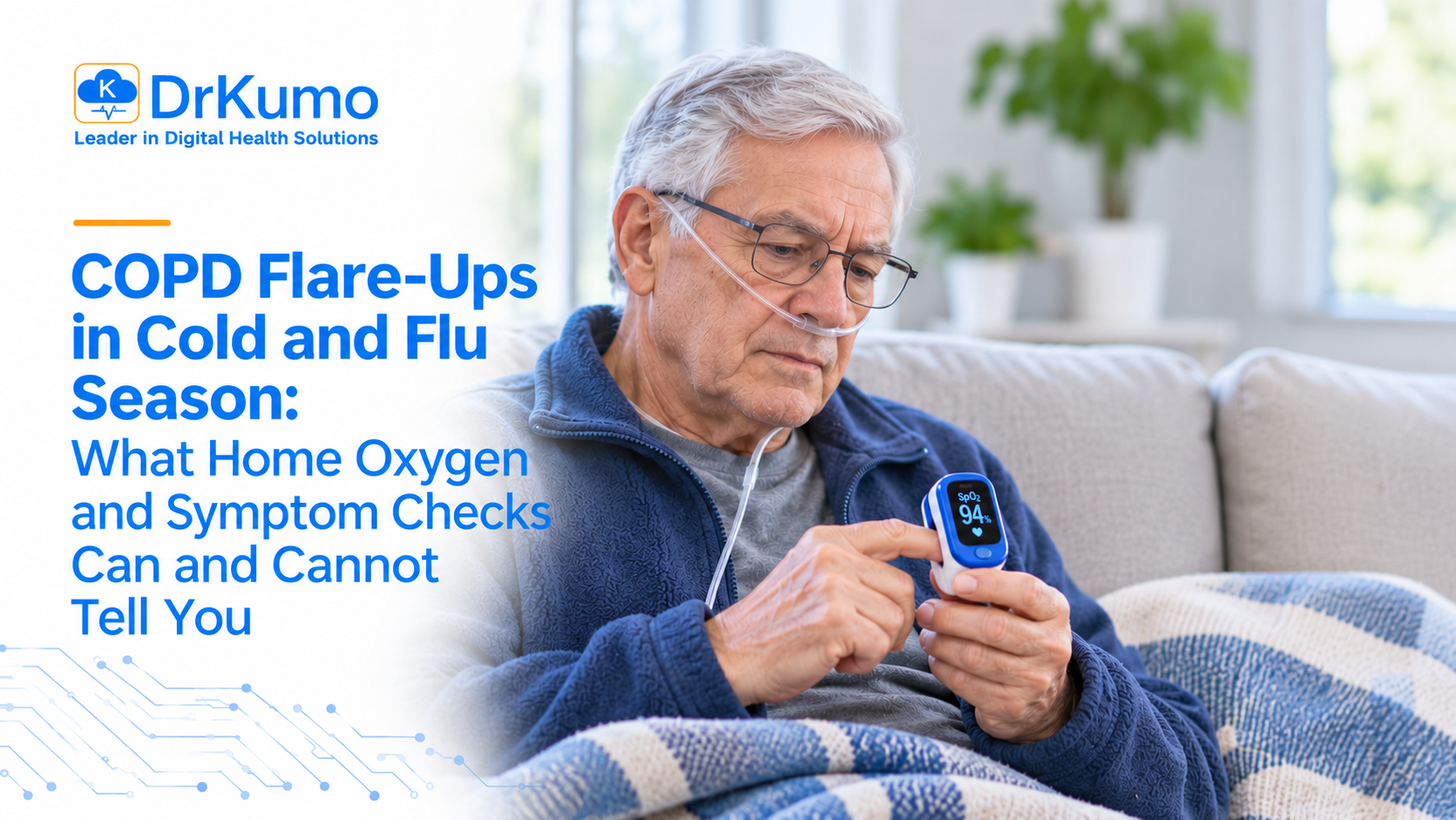
A pulse oximeter clips onto a fingertip and uses light beams to estimate the oxygen saturation of the blood and the pulse rate. FDA’s consumer guidance covers how to get a usable reading.
FDA on taking the reading
Make sure your hand is “warm, relaxed, and held below the level of the heart.” Remove any fingernail polish on that finger.
U.S. Food and Drug Administration, consumer update on home oxygen therapy.
One number on one morning says very little. The same measurement, taken the same way every day over weeks, can show a direction. That is the actual value of a daily check.
FDA is also explicit that the number is not the whole picture. Its instruction is to keep track of your symptoms and how you feel alongside any reading.
What a Pulse Oximeter Cannot Do
This is the part that gets left out of most articles on the subject, and it comes straight from FDA.
FDA on accuracy and limitations
FDA states that pulse oximeters “have limitations and a risk of inaccuracy under certain circumstances,” including use on patients with darker skin pigmentation.
U.S. Food and Drug Administration, Pulse Oximeter Basics.
Six things FDA says can affect a reading
| Poor circulation | Skin pigmentation | Skin thickness |
| Skin temperature | Current tobacco use | Fingernail polish |
Two of those factors are ordinary winter facts. Cold hands and sluggish circulation both affect a reading, which is why FDA mentions warming the hand first.
The most important point is the one about symptoms. FDA advises not relying only on a pulse oximeter, and contacting a health care provider if your symptoms are serious or get worse. A reassuring number does not cancel out how you feel.
The short version | |
CAN tell you ✓ An estimate of oxygen saturation and pulse rate at one moment ✓ A direction, when the same measurement is taken the same way over weeks ✓ Something concrete to report to the person who manages your COPD | CANNOT tell you ✗ Whether you are having a flare-up, or whether you have an infection ✗ That you are fine when you feel worse. A reassuring number does not cancel out symptoms ✗ When to call. That threshold is set by your clinician, not by the device |
No number appears in this article
That is deliberate. What counts as low for you depends on your lungs, your usual range, and whether you use supplemental oxygen, and it is set by the clinician who manages your COPD. An article cannot set it, and a device cannot set it either.
Where FDA Oversight of These Devices Stands Now
The accuracy question has an open regulatory file, which is worth knowing if you are buying a device this winter.
On January 7, 2025, FDA issued draft guidance on pulse oximeters for medical purposes, covering performance testing and labeling. FDA states that when finalized it will supersede the 2013 guidance document.
As of this writing the guidance is still in draft, and draft guidance is non-binding. FDA also notes that it reviews the accuracy of prescription pulse oximeters, not over-the-counter devices sold for general wellness.
Prescription devices Reviewed by FDA for accuracy. If your care team supplies a device, ask which category it falls into. | Over-the-counter wellness devices Sold for general wellness and not reviewed by FDA for accuracy the same way. Treat the reading accordingly. |
When to Get Help Right Away
The ALA advises seeking immediate medical attention for severe shortness of breath, chest pain, confusion, bluish lips or fingertips, or symptoms that are getting worse quickly.
In an emergency Do not stop to take a reading. Call 911. Call 911 or go to the nearest emergency department. A pulse oximeter is not a triage tool, and a number on a screen is not a reason to wait. |
What to Set Up Before You Need It
Keep your provider’s phone number, your hospital’s number, the name of someone who can drive you, directions to both, and a list of your medicines where you can find them. That is a ten-minute job in November and an impossible one mid-flare.
Three other things are worth raising at an appointment.
Before the season turns
| 1. | Ask your provider to write down what they want you to do when symptoms change, and what would make them want to hear from you. |
| 2. | Ask whether the practice runs a Remote Patient Monitoring (RPM) program and whether you would qualify for it. |
| 3. | Ask which vaccines they recommend for you. CDC recommends vaccines against COVID-19, influenza, and pneumococcal disease for people with COPD. |
Where Daily Checks Fit in a Monitoring Program
Look again at what FDA actually recommends: take the reading the same way, keep track of how you feel alongside it, and contact a provider when symptoms worsen. That is a sound instruction and a tedious one.
Notebooks get lost, the numbers blur together, and a reading from three weeks ago is hard to find on the morning you need it.
RPM is that instruction without the notebook. A connected pulse oximeter sends the reading to your care team on the schedule your practice sets, and the record builds itself.
The same test, applied to monitoring | |
What RPM CAN change ✓ You are not the only one looking. Someone on the care team sees the readings between appointments. ✓ Context when you call. The conversation starts from weeks of readings rather than from what you can remember. ✓ Often covered. Medicare and many other insurers cover these services when a practice offers them and the patient qualifies. ✓ Lighter on caregivers. The family member who has been asking what it said this morning stops being the record keeper. | What RPM CANNOT do ✗ Diagnose a flare, detect an infection, or treat anything. ✗ Watch you around the clock. Patients are not monitored around the clock. ✗ Act as an emergency service, or replace the call the ALA and NHLBI tell you to make when symptoms worsen. ✗ Make the clinical decision. That rests with your provider. |
What it changes is whether your readings are sitting in a drawer or in front of your care team. | |
Whether a program suits you is a question for your provider, and a short one: ask whether the practice offers RPM and whether you would qualify.
How DrKumo Supports Respiratory Monitoring Programs
DrKumo builds the secure, HIPAA-compliant RPM technology solutions that practices use to run programs like these, using medical devices as defined by the FDA. Readings arrive with the date and time attached and organized by patient, so a care team looking at a winter pattern is looking at a record rather than a recollection.
For respiratory populations, DrKumo’s Disease Management Protocols give care teams structured clinical pathways for conditions including COPD, and the same record keeping supports FQHCs and RHCs and community providers serving patients in rural communities, where the nearest emergency department may be an hour away.
DrKumo is a technology company and is not a clinical entity. The clinical judgment stays with your own care team. RPM supports monitoring only, does not detect, diagnose, or treat illness, and does not replace in-person or emergency care.
Key Takeaways
Respiratory infection is the winter risk that CDC, NHLBI and the ALA all point to for people with COPD. The ALA names a cold, the flu, or a sinus infection as the most common trigger of increased COPD symptoms. Cold air is a real complaint, but the patient guidance puts its weight on infection, irritants, and vaccination.
A home pulse oximeter is useful for what FDA says it is useful for: a reading taken the same way each day, tracked alongside your symptoms, and reported to a provider so changes can be seen over time. It is not a verdict. FDA is clear that pulse oximeters have limitations and a risk of inaccuracy, and that skin pigmentation, circulation, skin temperature, tobacco use and nail polish can all affect a reading. FDA’s draft guidance on device testing and labeling, issued January 7, 2025, has not been finalized.
No number in this article tells you when to call, because that threshold is yours and your clinician’s to set. What is worth doing before the season turns is simple enough: ask for a written plan, ask whether the practice runs a monitoring program you would qualify for, ask which vaccines apply to you, and keep the phone numbers somewhere you can reach them one-handed. And when something turns severe, the answer is not another reading. It is 911.
For care teams and program leaders
Monitoring workflows your respiratory patients can keep up with.
If your organization runs an RPM program for respiratory patients, our team can walk you through how DrKumo supports secure, HIPAA-compliant monitoring workflows. If you are living with COPD, the next step is a conversation with your own provider.
Frequently Asked Questions
Common questions about winter COPD flare-ups and home oxygen checks.
Why do COPD flare-ups happen more in cold and flu season
CDC states that lung infections can cause serious problems for people with COPD, and the ALA names respiratory infections such as a cold, the flu, or a sinus infection as the most common cause of increased COPD symptoms. A virus inflames airways that are already narrowed, producing swelling and more mucus.
What oxygen level should I call my doctor about
There is no single number that applies to everyone. What counts as low depends on your lungs, your usual range, and whether you use supplemental oxygen, and it is set by the clinician managing your COPD. FDA advises contacting a health care provider if you are concerned about a reading, or if your symptoms are serious or get worse.
Are home pulse oximeters accurate
FDA states that pulse oximeters have limitations and a risk of inaccuracy under certain circumstances, including use on patients with darker skin pigmentation. FDA lists poor circulation, skin pigmentation, skin thickness, skin temperature, current tobacco use and fingernail polish as factors that can affect a reading, and advises not relying on the device alone. FDA reviews the accuracy of prescription pulse oximeters, not over-the-counter devices sold for general wellness.
What are the warning signs of a COPD flare-up
The ALA lists more coughing, changes to the mucus you cough up including color, thickness or amount, wheezing or noisy breathing, and difficulty sleeping, alongside shortness of breath worse than your usual level. It advises seeking immediate medical attention for severe shortness of breath, chest pain, confusion, bluish lips or fingertips, or rapidly worsening symptoms.
What remote monitoring can and cannot do for COPD
What it does is put your daily readings in front of your care team between appointments, so a change in your usual pattern is visible to them rather than sitting in a notebook. What it does not do is diagnose a flare, detect an infection, or treat anything, and patients are not monitored around the clock. The clinical judgment, and any decision about treatment, rests with your provider.
Has FDA changed the rules for pulse oximeters
FDA issued draft guidance on January 7, 2025 covering performance testing, labeling and premarket submissions for pulse oximeters used for medical purposes, and states that it will supersede the 2013 guidance once finalized. As of this writing the guidance remains in draft form and is non-binding.
References
American Lung Association. (2026). Prevent a COPD exacerbation or flare up. Lung.org.
Centers for Disease Control and Prevention. (2026). About COPD. CDC.gov.
National Center for Health Statistics. (2025). Diagnosed chronic obstructive pulmonary disease in adults (Data Brief No. 529). CDC.gov.
National Heart, Lung, and Blood Institute. (2026). COPD. NHLBI.nih.gov.
U.S. Food and Drug Administration. (2025). Pulse oximeter basics. FDA.gov.
U.S. Food and Drug Administration. (2025). Pulse oximeters and oxygen concentrators: What to know about home oxygen therapy. FDA.gov.
U.S. Food and Drug Administration. (2025). Pulse oximeters. FDA.gov.
Disclaimer: This article is for information only and is not medical advice. It summarizes public health and consumer guidance from the Centers for Disease Control and Prevention, the National Heart, Lung, and Blood Institute, the U.S. Food and Drug Administration, and the American Lung Association, and does not describe any individual’s situation. It does not provide oxygen saturation thresholds, action plans, or instructions for managing COPD, an infection, or supplemental oxygen. Always consult a licensed healthcare provider about diagnosis, treatment, vaccines, oxygen use, medication, or any change to your care plan, and do not change a prescribed treatment on your own. If you think you are having a medical emergency, call 911 or go to the nearest emergency department. DrKumo is a healthcare technology provider and is not a clinical entity. RPM supports monitoring only, does not detect, diagnose, or treat illness, and does not replace in-person or emergency care. References to the Centers for Disease Control and Prevention (CDC), the National Institutes of Health (NIH), and the Food and Drug Administration (FDA) do not constitute or imply an endorsement by CDC, NIH, the FDA, or the U.S. Government.