
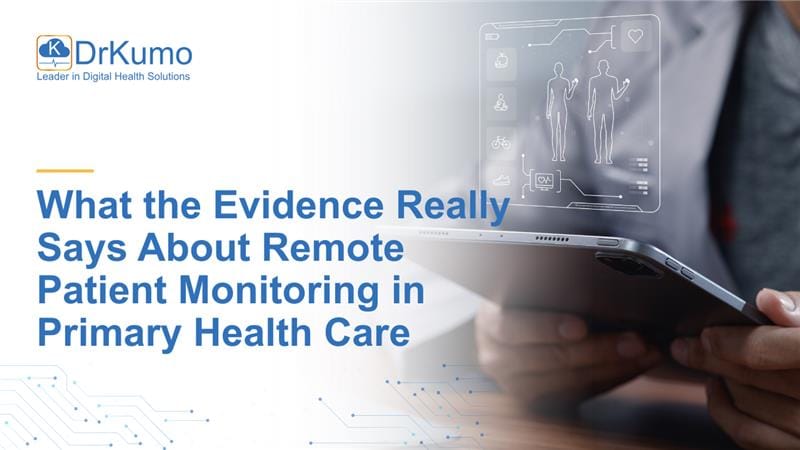
Remote Patient Monitoring (RPM) is often positioned as a promising approach for managing chronic illnesses in primary health care. By enabling patients to transmit health data from home and allowing clinicians to review that data remotely, RPM aims to support earlier intervention, continuity of care, and more efficient use of clinical resources. However, the real-world effectiveness of RPM depends heavily on how it is designed, implemented, and integrated into primary care workflows.
A 2020 overview of systematic reviews conducted by the Norwegian Institute of Public Health (NIPH) evaluated whether RPM—when delivered within primary health care and involving provider follow-up, improves clinical outcomes or health care utilization for patients with chronic illnesses.
How This Study Defined Remote Patient Monitoring
The NIPH review applied a strict and clinically relevant definition of RPM tailored to primary health care. RPM was defined as a three-step process:
- Data transmission – patients collect and transmit biometric or symptom data from home
- Data evaluation – transmitted data is reviewed by health care personnel or a monitoring service
- Clinical follow-up – providers intervene when data indicates potential deterioration
The review intentionally excluded:
- Fully automated systems without provider involvement
- Internet-only or mobile-app–only interventions
- RPM delivered solely in specialist or hospital-based settings
This definition reflects RPM as a clinical support process, not a consumer wellness application or a standalone technology.
Which Chronic Conditions Were Studied
Despite searching broadly across chronic diseases, the review identified eligible randomized controlled trials only for:
- Type 1 and Type 2 diabetes
- Hypertension
Across the included trials:
- Patients were typically aged 51 to 73 years
- Only a small proportion had multiple chronic conditions
- Interventions lasted 6 to 12 months
There was no strong primary-care evidence for this type of RPM in conditions such as chronic lung disease, cancer, musculoskeletal disorders, or mental health conditions.
Clinical Outcomes: What RPM Did and Did Not Improve
Clinical outcomes are a central consideration when evaluating reremote patient monitoring, particularly in understanding where it may support care delivery and where its impact is more limited.
Glycemic Control in Diabetes
RPM was associated with a small reduction in HbA1c, but the improvement was often below clinically meaningful thresholds. Only a minority of studies exceeded the commonly referenced 0.5% HbA1c reduction.
What this means: Monitoring alone is insufficient to produce meaningful glycemic improvement without integrated treatment adjustment and behavioral support.
Blood Pressure in Hypertension
RPM resulted in a slight reduction in systolic blood pressure, with no meaningful change in diastolic pressure. The magnitude of improvement was small and of uncertain clinical importance.
What this means: Awareness of readings helps, but blood pressure control still depends on medication titration and patient adherence, elements RPM does not automatically deliver.
Other Outcomes
The review found little to no difference between RPM and usual care for:
- Hospitalizations or emergency visits
- Cholesterol levels
- Mental health outcomes
- Most secondary clinical measures
One consistent finding was a small negative effect on the physical component of health-related quality of life, potentially reflecting increased treatment burden or monitoring fatigue.
What this means: More frequent monitoring does not necessarily improve how patients feel or function physically.
Health Care Utilization and Cost Findings
The evidence did not show consistent reductions in:
- Hospital admissions
- Emergency department utilization
- Primary care visits
Only one trial included a formal economic evaluation, which suggested RPM was relatively costly per quality-adjusted life year gained.
What this means: RPM should not be implemented with the expectation of automatic cost savings or utilization reduction.
Why RPM Showed Limited Impact in Primary Care
The authors identify several structural reasons for limited effectiveness:
- Many interventions were single-component, focused on data transmission rather than comprehensive care
- Follow-up was often reactive, triggered only by abnormal readings
- Usual care was poorly described, making incremental benefit difficult to assess
- Behavior change, not data availability, was often the limiting factor
RPM functioned primarily as a data and communication mechanism, not a full disease management solution.
What This Evidence Means for Primary Health Care
The findings suggest RPM should be understood as an enabling infrastructure, not a standalone intervention. In primary care, RPM is most appropriate when it is:
- Embedded in structured care pathways
- Paired with clear escalation and treatment protocols
- Integrated into care team workflows
- Designed to minimize patient burden
Primary care organizations should focus on how RPM is used, not just whether it is used.
How DrKumo Aligns with the Evidence
DrKumo’s approach to remote patient monitoring reflects the same principles emphasized in the NIPH review: provider involvement, structured follow-up, and integration into primary care workflows.
DrKumo supports RPM as a care management solution, not a passive data feed. Its platform is designed to:
- Support secure transmission of clinically relevant data from approved devices
- Support provider review and care team coordination
- Facilitate timely follow-up when patient data indicates potential risk
- Integrate RPM into broader chronic care and disease management workflows
In this context, DrKumo does not position RPM as a cure or guarantee of improved outcomes. Instead, it supports the operational conditions under which RPM can be clinically useful, consistent with the evidence: clear workflows, defined responsibilities, and provider-led decision-making.
Implications for Future RPM Programs
The review highlights major gaps that future RPM programs including those supported by platforms like DrKumo—must address:
- Limited evidence in multimorbidity
- Exclusion of patients with mental health conditions
- Underrepresentation of patients with sensory or functional impairments
- Lack of qualitative insight into patient and provider experience
Addressing these gaps will require multi-component interventions, participatory design, and closer alignment with real-world primary care practice.
Takeaways
High-quality evidence from primary health care shows that RPM, when implemented narrowly as monitoring plus reactive follow-up, produces limited clinical benefit for diabetes and hypertension. Small improvements in select measures do not consistently translate into better utilization or patient-reported outcomes.
To learn how DrKumo supports secure, HIPAA-compliant remote patient monitoring that aligns with evidence-based primary care workflows, contact us today. Our team is ready to support organizations seeking to implement RPM responsibly and effectively.
Disclaimer: This article is provided for informational and educational purposes only and does not constitute medical, clinical, or policy advice. The findings summarized are based on a specific definition of remote patient monitoring and a defined body of evidence. Results may not generalize to all RPM technologies, care models, or patient populations. Health care organizations should consult qualified clinical and compliance professionals when designing or implementing RPM programs.