
Healthcare Providers · Remote Patient Monitoring · Clinical Documentation
7 min read
RPM
HIPAA
CMS
Remote Patient Monitoring (RPM) facilitates the collection of physiologic data, which can assist healthcare providers in managing chronic conditions. Learn how DrKumo RPM technology supports information organization and clinical documentation.
RPM Adoption at a Glance
In the current healthcare environment, monitoring patient health outside of the traditional clinic setting is a recognized approach to support care coordination. According to the Centers for Disease Control and Prevention (CDC), 6 in 10 adults in the United States live with at least one chronic condition, and 4 in 10 live with two or more. Industry analysis from Insider Intelligence indicates that adoption of Remote Patient Monitoring (RPM) had already reached approximately 30 million U.S. patients in 2024, with adoption projected to continue growing through the second half of the decade.
That adoption produces a significant volume of physiologic data from medical devices such as blood pressure monitors, glucometers, and weight scales. The value of that data depends on whether it can be organized into structured documentation that supports periodic provider review and meets institutional standards for record-keeping, security, and reimbursement.
This article explains how RPM technology supports clinical documentation, how workflows align with National Institute of Standards and Technology (NIST) and National Cybersecurity Center of Excellence (NCCoE) cybersecurity guidance, and how to maintain Health Insurance Portability and Accountability Act (HIPAA) compliant data practices throughout the data lifecycle.
How Does RPM Data Improve Clinical Documentation?
RPM data improves clinical documentation by transforming raw readings into structured, time-stamped records that can be reviewed inside a provider’s regular workflow. Instead of relying solely on patient self-reporting during office visits, clinicians can document trends drawn from consistent device transmissions.
Three practical benefits stand out:
- Structured Records. Device readings are stored in consistent formats with time stamps, supporting cleaner clinical notes and reducing transcription effort.
- Trend Visibility. Patterns across days or weeks are easier to surface than single-point readings, supporting more informative care plan documentation.
- Standardized Review. Provider-defined thresholds give clinical teams a uniform way to flag data points that warrant notes, follow-up, or escalation.
For organizations deploying these medical devices, clear documentation practices are essential for operational consistency. A practical foundation for setting up these workflows is available in our comprehensive guide to Remote Patient Monitoring.
How Do RPM Workflows Handle Physiologic Data Day to Day?
RPM workflows move physiologic data through three repeatable steps. Each step generates documentation artifacts that support clinical decisions and administrative requirements.
Collect
Patients use FDA-defined medical devices at home. Devices transmit readings on a scheduled basis.
Evaluate
Provider-defined thresholds trigger notifications when readings fall outside expected parameters.
Document
Clinicians review flagged readings and document assessments inside their established workflow.
RPM does not replace emergency care. Patients experiencing urgent symptoms should contact appropriate medical services directly.
How Does RPM Support Oversight of Chronic Conditions?
Patients with chronic conditions such as hypertension, heart failure, and chronic obstructive pulmonary disease (COPD) benefit from regular data visibility between office visits. RPM provides physiologic readings that clinicians can review as part of their established review schedule, supporting clinical decision-making without replacing in-person evaluations.
When standardized clinical protocols are paired with RPM, clinical teams gain procedural consistency. Provider-led disease management protocols can be used to define how data points are reviewed, what thresholds apply, and what documentation is required at each review interval.
Hypertension monitoring benefits from systolic and diastolic ranges adjusted per patient. Heart failure monitoring is typically anchored to daily weight deltas. COPD oversight commonly tracks oxygen saturation patterns. Thresholds should reflect each patient’s clinical baseline and the relevant provider-led protocol.
What CMS and HIPAA Requirements Apply to RPM Data?
RPM data is subject to two distinct sets of requirements that operate on different layers. CMS governs reimbursement and documentation. HIPAA governs privacy and security. Compliance with one does not imply compliance with the other.
| CMS (Reimbursement) | HIPAA (Privacy and Security) |
|---|---|
| Governs RPM billing and reimbursement under specific CPT codes. | Governs the handling of protected health information. |
| Requires device data on at least 16 days within a 30-day period for most RPM CPT codes. | Requires safeguards for data transmission, storage, access, and incident response. |
| Documentation must support the data volume, clinical time, and patient participation. | Aligns well with NIST and NCCoE cybersecurity guidance for RPM. |
| Applies primarily at the billing and audit layer. | Applies across the entire data lifecycle. |
Plan separate audit trails for CMS billing documentation and HIPAA privacy and security. A workflow that satisfies a CMS billing review may still have HIPAA gaps, and vice versa. Map your RPM program against both frameworks during the design phase, not after deployment.
For a closer look at the cybersecurity considerations specific to RPM deployments, see our analysis of the NIST and NCCoE cybersecurity framework for RPM practices.
Raw readings are not documentation. Documentation is what happens when a clinician reviews organized data inside a structured workflow.
DrKumo Editorial Team
How Does DrKumo Organize RPM Data for Clinical Teams?
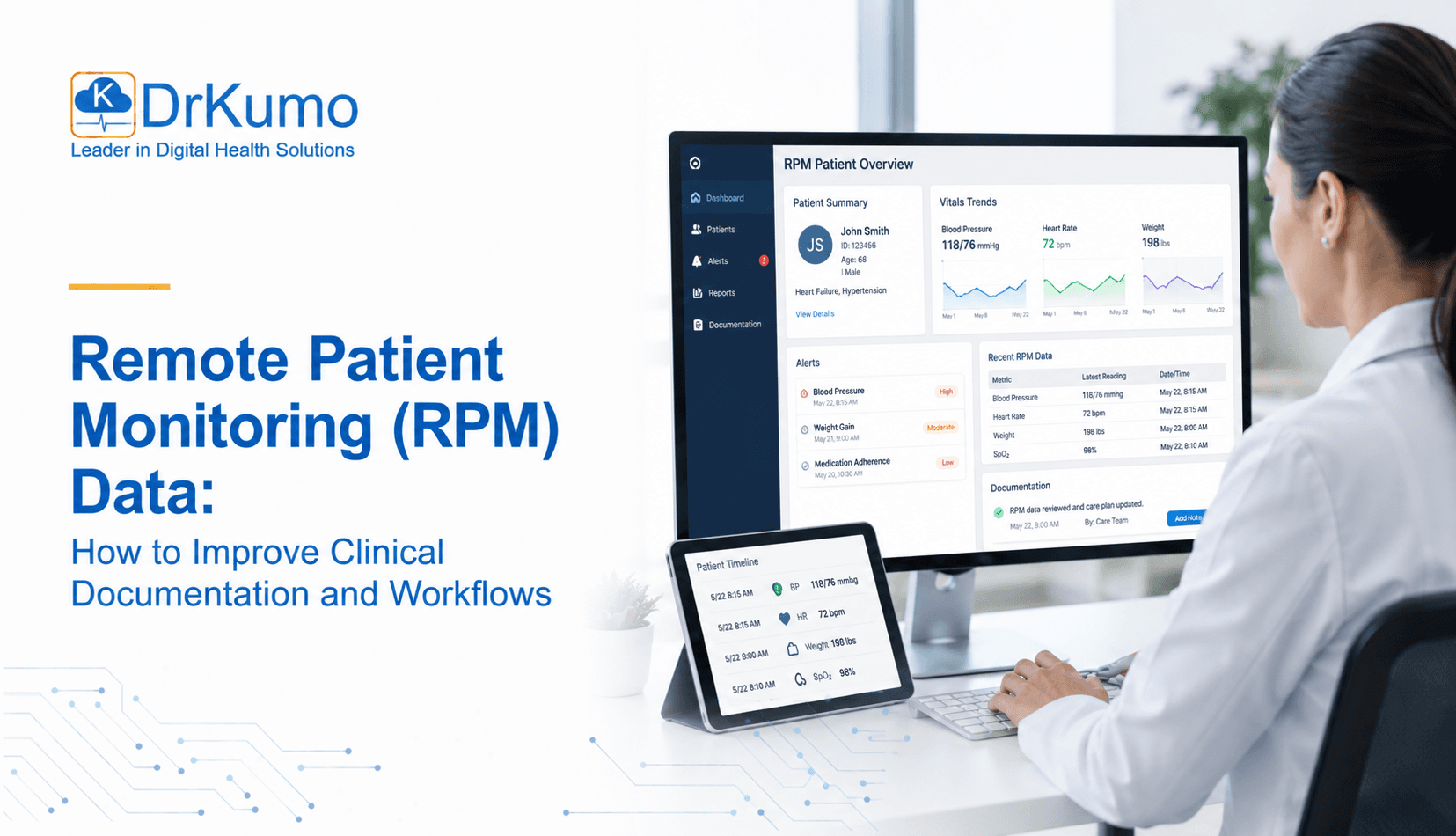
DrKumo provides the technical infrastructure that supports clinical teams in turning physiologic data streams into reviewable documentation. The platform supports the collection of data from Remote Patient Monitoring medical devices, as defined by the FDA, and centralizes that data into a structured dashboard for clinical review.
Key infrastructure principles include:
Centralized Data Flow
Disparate device readings are consolidated into a single uniform view, supporting periodic review and consistent documentation.
Established Cybersecurity Controls
The platform aligns with NIST and NCCoE cybersecurity guidance to support HIPAA-compliant workflows for covered entities.
Scalable Transmission
Data movement from devices to the provider’s repository is designed to remain consistent as patient populations grow.
Standardized Formats
Structured data formats support clinical documentation that aligns with institutional and reimbursement requirements.
The platform is a support technology. Clinicians remain the responsible decision-makers for diagnostic, treatment, and care coordination decisions. RPM is for monitoring purposes only and does not replace emergency care.
Frequently Asked Questions About RPM Data and Documentation
Takeaways
RPM data delivers value when it becomes organized documentation, not when it is simply collected. Structured records, provider-defined thresholds, and consistent review schedules turn physiologic readings into a clinical and administrative asset. Workflows that align with NIST and NCCoE cybersecurity guidance and support HIPAA-compliant practices help organizations manage these data streams responsibly.
DrKumo is not a clinical entity and does not provide clinical services. DrKumo provides the technical infrastructure that supports clinicians in organizing, documenting, and reviewing RPM data within their established workflows. The clinician remains the responsible decision-maker, and RPM is intended for monitoring purposes only. It does not replace emergency care.
Structured RPM data, documented the right way
Turn your RPM data stream into reviewable documentation.
Contact DrKumo to learn how our infrastructure supports clinical documentation, HIPAA-aligned workflows, and structured periodic review for your RPM program.