· 8 min read
Respiratory Season
Chronic Conditions
CDC Guidance
A respiratory infection is rarely just a respiratory infection when you live with diabetes, COPD, or heart failure. The cough and the fever are the obvious parts. What often matters more is what happens underneath, to the numbers you or your care team already watch.
This is not a rare combination. The U.S. Centers for Disease Control and Prevention (CDC) reported that during the 2023 to 2024 season, about 9 out of 10 people hospitalized with flu had at least one chronic medical condition, and surveillance for the 2024 to 2025 season put the figure at 89.1 percent.
9 in 10 people hospitalized with flu had at least one chronic medical condition, 2023 to 2024 season | About 30% of adults hospitalized with flu and reported to CDC had diabetes, in recent seasons | 79% the reduction in hospitalizations that CDC reports flu vaccination has been associated with among people with diabetes |
Why These Infections Hit Harder With a Chronic Condition
CDC lists chronic lung disease including COPD, heart disease, diabetes, and chronic kidney disease among the conditions that raise the risk of severe illness from respiratory viruses, including flu, COVID-19, and RSV.
One line from CDC is worth sitting with. People with diabetes are at higher risk of serious flu complications even when the condition is well managed. Good control is protective in many ways, but it does not take you off the higher-risk list.
Part of what makes these infections harder is that they rarely stay in one lane. CDC includes the worsening of chronic medical conditions in its own list of flu emergency warning signs, alongside trouble breathing and chest pain.
What Can Happen to the Numbers You Watch
Everyone is different, and your care team knows your situation. These are patterns, not predictions.
If you have diabetes CDC notes that flu may raise blood sugar, and that it can also send blood sugar down if you are not eating or drinking as usual. Either direction can show up before you feel much worse. | If you have COPD Respiratory infections are a common trigger for a flare. More breathlessness than usual, a change in cough, or a change in mucus are the kinds of shifts care teams ask about. | If you have heart failure An infection asks more of the heart. Weight, swelling, and breathlessness are the signals many heart failure plans are built around. |
What Is Deliberately Missing
Numbers to act on. There is no universal threshold that means call, and none that means wait. The plan that fits you comes from the clinician who knows your history, your medications, and your usual range.
If you do not have a written plan for sick days, that is a worthwhile thing to ask for at your next appointment, well before you need it.
When to Get Help Right Away
CDC lists the following emergency warning signs for flu in adults. They apply whether or not you have a chronic condition, and CDC’s advice is to get medical care right away.
- Difficulty breathing or shortness of breath
- Persistent pain or pressure in the chest or abdomen
- Persistent dizziness, confusion, inability to arouse
- Seizures
- Not urinating
- Severe muscle pain
- Severe weakness or unsteadiness
- Fever or cough that improve but then return or worsen
- Worsening of chronic medical conditions
CDC is clear that this list is not complete, and advises consulting your medical provider about any other symptoms that are severe or concerning. If something feels like an emergency, call 911 or go to the nearest emergency department. Do not wait for a callback, and do not wait to see what a reading says.
Why the First Couple of Days Matter
CDC recommends prompt antiviral treatment for people at higher risk who have flu or suspected flu, and advises contacting a healthcare provider right away when symptoms appear. For flu and COVID-19 alike, CDC notes that treatment has to start within a few days of symptoms beginning to do its work.
That timing is the practical reason to call early rather than wait out the first day or two. Whether treatment is right for you is your clinician’s call, but it is a call that gets harder to make as the window closes.
What Lowers the Risk Before the Season Starts
CDC describes vaccination as the best protection against severe respiratory illness, and recommends talking with a healthcare provider about which vaccines apply to you.
For people with diabetes specifically, CDC recommends the injectable flu vaccine each year rather than the nasal spray, and points to keeping pneumococcal vaccination up to date. It also suggests a practical step that has nothing to do with vaccines: keeping at least a two-week supply of your regular medications on hand, so a bad week does not become a pharmacy run you are in no shape to make.
Questions Worth Asking Before You Are Sick
Sick day plan Can you write down what I should do on a sick day, and what would make you want to hear from me? | Treatment window If I come down with something, how fast do I need to reach you for treatment to still be an option? |
Vaccines Which vaccines do you recommend for me this year, and when should I get them? | After hours What is the fastest way to reach your team after hours, and what should go to 911 instead? |
Ask once, write the answers somewhere you will find them, and the question stops being urgent.
Where Remote Monitoring Fits, and Where It Does Not
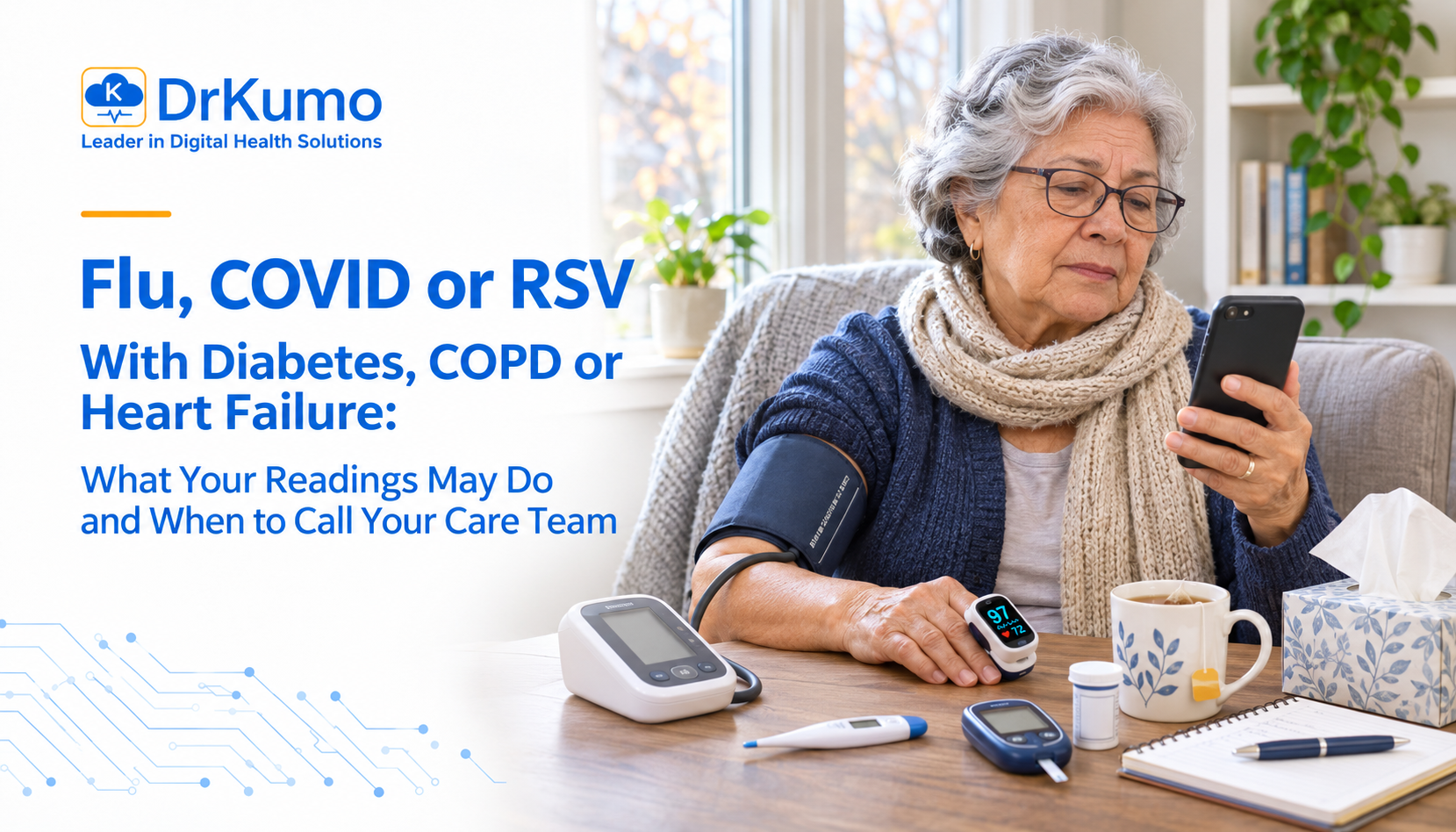
Plenty of people with these conditions already check something at home: a glucose meter, a scale, a pulse oximeter, a blood pressure cuff. Some are enrolled in a remote monitoring program through their practice, which means those readings travel to the care team on a schedule rather than waiting for the next appointment. During an illness, that can shorten the distance between a change and a conversation. It is a communication channel, nothing more.
To Be Direct About the Limits
Remote monitoring does not detect, diagnose, or treat an infection. Nobody is watching a screen around the clock. It does not replace an appointment, and it is never the right channel for an emergency. If you are sick enough to wonder, that is a phone call, and if it feels like an emergency, that is 911.
DrKumo builds Remote Patient Monitoring (RPM) technology solutions that practices use to run programs like these, using secure, HIPAA-compliant systems and medical devices as defined by the FDA. It is a technology company, not a healthcare provider, and every clinical decision belongs to your own care team. Organizations weighing how a program is structured can review DrKumo’s comprehensive guide to RPM. Whether a monitoring program suits you is a question for your clinician.
Key Takeaways
Flu, COVID-19, and RSV ask more of a body that is already managing diabetes, COPD, or heart failure, and CDC puts the scale of that plainly: about 9 out of 10 people hospitalized with flu in the 2023 to 2024 season had at least one chronic medical condition, and about 30 percent of adults hospitalized with flu and reported to CDC had diabetes. Good control helps, but CDC is explicit that people with diabetes remain at higher risk even when the condition is well managed.
The numbers you track at home often move during an illness, sometimes before you feel much worse. What those movements mean is specific to you, which is why the useful version of this article is not a threshold to memorize, but a plan written with your clinician before the season gets going. The same goes for vaccines, which CDC describes as the best protection, and for timing: treatment for flu or COVID-19 has to start within a few days of symptoms to help.
And when something crosses from worrying into frightening, skip the deliberation. CDC’s warning signs include trouble breathing, chest or abdominal pain, confusion, and the worsening of a chronic condition you already live with. Those are reasons to seek care right away, or to call 911. DrKumo is a technology provider and is not a clinical entity, and RPM supports monitoring between visits rather than replacing in-person or emergency care.
Patients and caregivers: the right next step is a conversation with your own care team, not with us.
Frequently Asked Questions
Common questions about respiratory infections when you live with diabetes, COPD, or heart failure.
Does the flu raise blood sugar?
CDC notes that flu may raise blood sugar, and that blood sugar can also drop if you are not eating or drinking as much as usual. CDC advises people with diabetes to follow the sick day guidelines their care team has given them and to contact a provider when they become ill.
Why are flu, COVID-19, and RSV riskier with COPD or heart failure?
CDC lists chronic lung disease including COPD, heart disease, diabetes, and chronic kidney disease among the conditions that raise the risk of severe illness from respiratory viruses. CDC also includes the worsening of a chronic medical condition in its list of flu emergency warning signs.
When should I call my care team instead of waiting it out?
CDC advises people at higher risk to contact a healthcare provider right away when flu symptoms appear, because antiviral treatment needs to begin within a few days of symptoms starting. Your own care team can tell you what should prompt a call for your situation. For CDC’s emergency warning signs, the guidance is to get medical care right away, and for anything that feels like an emergency, call 911.
Do vaccines help if I already have a chronic condition?
CDC describes vaccination as the best protection against severe respiratory illness and recommends discussing which vaccines apply to you with a healthcare provider. CDC reports that flu vaccination has been associated with a 79 percent reduction in flu-related hospitalizations among people with diabetes.
Can remote monitoring tell me if I have the flu?
No. Remote monitoring does not detect, diagnose, or treat an infection, and patients are not monitored around the clock. It is a way for readings taken at home to reach a care team between visits. Testing, diagnosis, and treatment all happen through your clinician.
References
Centers for Disease Control and Prevention. Signs and Symptoms of Flu. CDC.gov.
Centers for Disease Control and Prevention. Flu and People with Diabetes. CDC.gov.
Centers for Disease Control and Prevention. Risk Factors for Severe Illness from Respiratory Viruses. CDC.gov.
Centers for Disease Control and Prevention. (2024). People with Chronic Medical Conditions Continue to Account for the Majority of Flu Hospitalizations This Season. CDC.gov.
Centers for Disease Control and Prevention. (2025). Influenza-Associated Hospitalizations and Clinical Characteristics, 2024 to 2025 Season. Morbidity and Mortality Weekly Report, 74(34).
Disclaimer: This article is for information only and is not medical advice. It summarizes public health information from the Centers for Disease Control and Prevention (CDC) and does not describe any individual’s situation, and it does not provide thresholds, sick day rules, or instructions for managing diabetes, COPD, heart failure, or any infection. Always consult a licensed healthcare provider about diagnosis, treatment, vaccines, medication, or any change to your care plan, and do not change a prescribed medication on your own. If you think you are having a medical emergency, call 911 or go to the nearest emergency department. DrKumo is a healthcare technology provider and is not a clinical entity. RPM supports monitoring only, does not detect, diagnose, or treat illness, and does not replace in-person or emergency care. References to the Centers for Disease Control and Prevention (CDC) and the Food and Drug Administration (FDA) do not constitute or imply an endorsement by CDC, the FDA, or the U.S. Government.