· 7 min read
VA Telehealth
RPM-HT
Dole Act
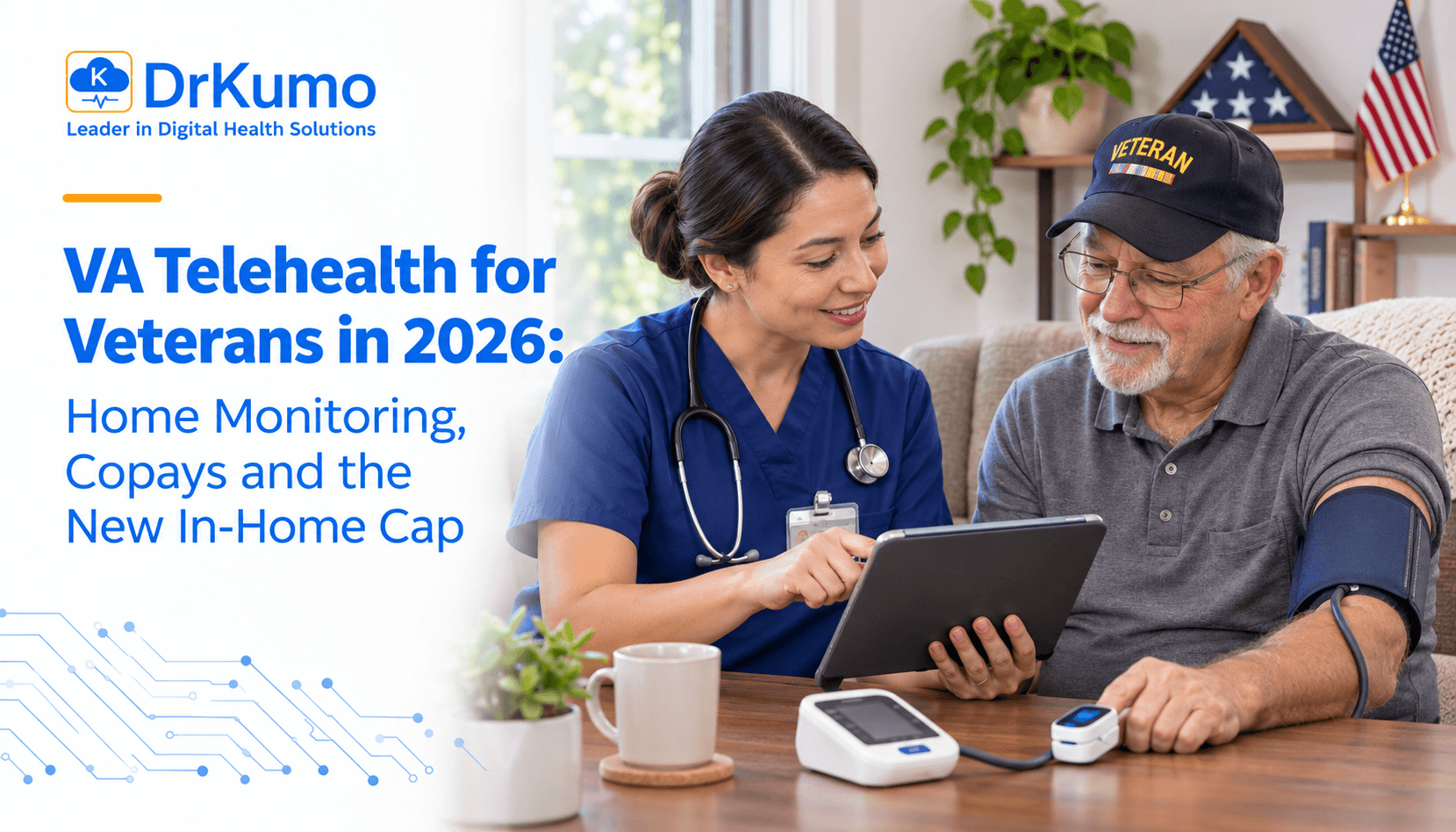
VA telehealth for Veterans now covers more ground than it did a few years ago. A Veteran enrolled in VA health care can meet a provider by video from the kitchen table, send a secure message, use VA equipment at home that forwards readings to a care team, or sit down in a private room closer to home than the medical center.
One of the biggest changes of 2025 had nothing to do with technology. It was a dollar limit. VA may now pay up to 100 percent of the nursing home rate for care delivered in a Veteran’s own home, up from 65 percent, a shift that lets more families keep care at home instead of moving.
This guide covers what VA offers from home right now, what it costs, how the in-home services change works, and when community care comes into the picture instead.
Before 65% of the nursing home rate was the most VA could pay for care in a Veteran’s own home | Now 100% is the ceiling, in effect since September 11, 2025, under Section 120 of the Senator Elizabeth Dole 21st Century Veterans Healthcare and Benefits Improvement Act |
What VA Telehealth Covers in 2026
Most Veterans end up using more than one of these, often without thinking of it as telehealth at all.
Video visits. An appointment with your care team from home, on a phone, tablet, or computer with internet. VA calls this VA Video Connect.
Messages and sent readings. Secure messaging through My HealtheVet, or sending readings such as blood pressure, glucose, or weight for your team to review later.
A site closer to home. Where home internet is a problem, some communities host Accessing Telehealth through Local Area Stations sites, known as ATLAS: private rooms set up for a VA video visit nearer than the medical center.
Any Veteran enrolled in VA health care can use telehealth. VA is also candid that it does not suit every condition or situation, which is why your care team helps sort what belongs on video from what needs an in-person visit.
How VA Home Monitoring Works and How to Ask for It
Remote Patient Monitoring-Home Telehealth, which VA shortens to RPM-HT, is the program where VA equipment at home sends your readings to a care coordinator who watches for changes. VA describes the goal plainly: catching worsening symptoms early, which can mean fewer hospital stays and fewer trips to the clinic or emergency room. The service is free to Veterans.
It is generally offered to Veterans managing conditions such as heart failure, chronic obstructive pulmonary disease, high or low blood pressure, chronic kidney disease, or diabetes. Facility lists vary, so a condition that is not named here is still worth asking about.
| 1 | Ask for a referral. Call your care team or send a secure message through My HealtheVet asking whether home monitoring fits your conditions. Every referral is reviewed for eligibility. |
| 2 | Equipment comes to you. The care coordinator picks what suits your situation. You may need a phone to reach staff, and the equipment needs a signal strong enough to send data. Requirements vary by facility and by the equipment chosen, so your care coordinator will confirm what applies to you. |
| 3 | You use it daily, they follow it. Answer the questions and send the readings asked for. Your coordinator reviews them, stays in touch between visits, and passes what matters to your providers. |
Caregivers are part of the design, not an afterthought. A spouse or adult child can be the one who helps with the equipment and talks to the coordinator.
Worth Saying Plainly
This is monitoring, not emergency care. Nobody is watching a screen around the clock. If something feels like an emergency, treat it as one and call 911 or go to the nearest emergency department.
What VA Telehealth Costs Veterans
In-home video telehealth has been exempt from VA copayments since 2012, and home monitoring is free to Veterans. For everything else, what you owe depends on your priority group, your service-connected status, and the type of care. Many Veterans owe nothing at all.
VA has also proposed exempting all telehealth services from copayments, in the Telehealth Grant Program rulemaking. That proposal has not been confirmed as finalized, so the broader exemption is not in effect yet. If a copay question affects a decision you are weighing, check the current status on VA.gov or in the Federal Register. For a copay bill you have already received, VA’s Health Resource Center answers at 866-400-1238, Monday through Friday, 8:00 a.m. to 8:00 p.m. Eastern time.
The In-Home Services Cap Rose to 100 Percent
Here is the practical version of the change shown at the top of this page. Under the old 65 percent ceiling, a Veteran whose care needs at home ran expensive could hit the limit and end up moving into a nursing home. The statutory ceiling, not a clinical judgment, was what set the limit on what VA could fund at home. Raising the ceiling to 100 percent removes that particular forced choice for a lot of families.
| January 2, 2025 | The Dole Act is signed into law, with Section 120 lifting the payment limit. |
| September 11, 2025 | VA guidance putting the change into practice takes effect. |
| January 12, 2026 | VA publishes its implementation notice in the Federal Register, with the September 2025 effective date. |
Six services sit under the raised ceiling: Homemaker and Home Health Aide, Home Respite, Community Adult Day Health Care, Veteran Directed Care, Skilled Home Health Care, and the Program of All-Inclusive Care for the Elderly, known as PACE.
Costs above 100 percent are still possible, handled case by case after a clinical review, and VA expects that to involve a small number of Veterans each year. In its implementation notice, VA said it anticipates the Veterans most likely to need care costing more than 100 percent of the nursing home rate are those with ALS or spinal cord injuries or disorders, while adding that it will still consider costs above that level for other Veterans.
None of it is automatic. VA decides eligibility for these services based on clinical need, so the conversation starts with your care team or a VA social worker.
When Community Care Applies Instead
Community care is a separate path, for when VA cannot provide the care close enough to home or soon enough. Two things are true in every case: you are enrolled in or eligible for VA health care, and you have approval from your VA team before you go, except for urgent or emergency care.
Beyond that, at least one of these has to apply. VA does not offer the service at any VA health facility. You live in a state or territory without a full-service VA health facility. You and your VA provider agree community care is in your best medical interest. VA cannot meet its own quality standards for that service. You qualified under the 40-mile distance requirement as of June 6, 2018, and live somewhere that still makes you eligible. Or VA cannot see you within its designated access standards, which are these.
| Type of care | Drive time | Wait time |
|---|---|---|
| Primary care, mental health, and extended outpatient care | 30-minute average | 20 days |
| Specialty care | 60-minute average | 28 days |
Approval comes before the appointment, not after. Seeing a community provider without it can leave you holding the bill.
Four Questions to Bring to Your VA Care Team
Home monitoring Would home monitoring be a fit for my conditions, and can you put in a referral? | Video visits Which of my appointments could be done by video instead of driving in? |
In-home services With the in-home services cap raised, does that change what help I can get at home? | Community care If the wait or the drive is too long, do I meet the community care standards? |
If you are a spouse, adult child, or caregiver asking on someone else’s behalf, the same four questions work.
Where DrKumo Fits in Home Monitoring
DrKumo builds technology solutions for remote patient monitoring programs. It is a technology company, not a healthcare provider: it does not deliver medical care, make clinical decisions, or decide who is eligible for anything. Those calls belong to VA and to your own care team. DrKumo earned URAC full accreditation in Telehealth Support Services 2.0: Technical Support Certification Program in 2022, and in 2023 was named one of four awardees on the VA Remote Patient Monitoring-Home Telehealth contract.
What its RPM technology solutions do day to day is narrow and practical. Readings taken at home are recorded with the date and time, organized by patient, and delivered to the care team in a form they can act on, using secure, HIPAA-compliant systems and medical devices as defined by the FDA. Organizations weighing how to run a monitoring program can review DrKumo’s comprehensive guide to remote patient monitoring. The clinical judgment stays where it belongs.
Key Takeaways
Telehealth is open to any Veteran enrolled in VA health care, whether that means a video visit from the kitchen table, a secure message to the care team, readings sent in for review, or a trip to an ATLAS site when the home internet will not cooperate. Home monitoring sits inside that set: free to Veterans, available by referral, and built around a care coordinator who follows your readings and stays in touch between visits.
Cost is less of a barrier than many people assume. In-home video telehealth has been exempt from VA copayments since 2012, and home monitoring carries no charge. VA has proposed extending that exemption to all telehealth services, but that rulemaking has not been confirmed as finalized, so it is not in effect yet. The larger shift is the in-home services cap, which rose from 65 percent of the nursing home rate to 100 percent effective September 11, 2025, giving families more room to keep care at home.
When VA cannot see you close enough or soon enough, community care is the other door: 30 minutes or 20 days for primary care, mental health, and extended outpatient care, 60 minutes or 28 days for specialty care, with approval arranged before the appointment rather than after. Every one of these decisions runs through VA and your own care team, which makes the practical next step a phone call or a secure message. DrKumo is a technology provider and is not a clinical entity, and RPM supports monitoring between visits rather than replacing in-person or emergency care.
If you work for a health organization building a monitoring program, our team is ready to answer your questions. To learn how DrKumo can help your organization deliver secure, HIPAA-compliant remote patient monitoring, contact us today.
Frequently Asked Questions
Common questions from Veterans and caregivers about VA telehealth, home monitoring, and what it costs.
Who is eligible for VA telehealth?
Any Veteran enrolled in VA health care can use telehealth. Your care team helps decide which visits work by video and which need to happen in person, since VA notes telehealth does not suit every condition or situation.
How do I get VA home monitoring equipment?
RPM-HT requires a referral from your VA care team. Call them or send a secure message through My HealtheVet and ask whether the program fits your conditions. Each referral is reviewed for eligibility, and the service is free to Veterans.
What is the new VA in-home services cap?
Section 120 of the Senator Elizabeth Dole 21st Century Veterans Healthcare and Benefits Improvement Act raised the limit on what VA may pay for noninstitutional care from 65 percent to 100 percent of the nursing home rate. VA guidance applies the change from September 11, 2025, and costs above 100 percent are reviewed case by case.
Does VA telehealth cost Veterans anything?
In-home video telehealth has been exempt from VA copayments since 2012, and RPM-HT is free to Veterans. Copays for other services depend on your priority group and service-connected status. VA has proposed exempting all telehealth from copayments, but that rulemaking has not been confirmed as finalized.
When can I see a community provider instead of VA?
You must be enrolled in or eligible for VA health care and get approval from your VA team first, except for urgent or emergency care. Then at least one eligibility condition must apply, such as VA not meeting its access standards of 30 minutes or 20 days for primary care, mental health, and extended outpatient care, or 60 minutes or 28 days for specialty care.
References
Congress.gov. (2025). Senator Elizabeth Dole 21st Century Veterans Healthcare and Benefits Improvement Act. 118th Congress.
Department of Veterans Affairs. (2026). Implementation of Section 120 of the Senator Elizabeth Dole 21st Century Veterans Healthcare and Benefits Improvement Act. 91 Fed. Reg. 1238.
Department of Veterans Affairs. (2012). Exempting In-Home Video Telehealth From Copayments. Federal Register.
Department of Veterans Affairs. (2024). Telehealth Grant Program. 89 Fed. Reg. 89519.
Department of Veterans Affairs. (2025). Eligibility for community care outside VA. VA.gov.
Department of Veterans Affairs. Remote Patient Monitoring-Home Telehealth (RPM-HT). VA.gov.
Department of Veterans Affairs. Manage your VA debt for benefit overpayments and copay bills. VA.gov.
Disclaimer: This article is for information only and is not medical, legal, or benefits advice. Eligibility for VA health care, telehealth, home monitoring, in-home services, and community care is determined by VA based on your individual circumstances, and program details and dollar limits can change. Always confirm your own situation with VA or your VA care team, and consult a licensed healthcare provider about diagnosis, treatment, medication, or any change to your care plan. If you think you are having a medical emergency, call 911 or go to the nearest emergency department. Veterans in crisis can reach the Veterans Crisis Line by dialing 988 and pressing 1. DrKumo is a healthcare technology provider and is not a clinical entity, and RPM supports monitoring only and does not replace in-person or emergency care. References to the U.S. Department of Veterans Affairs (VA) and the Food and Drug Administration (FDA) do not constitute or imply an endorsement by the VA, the FDA, or the U.S. Government.