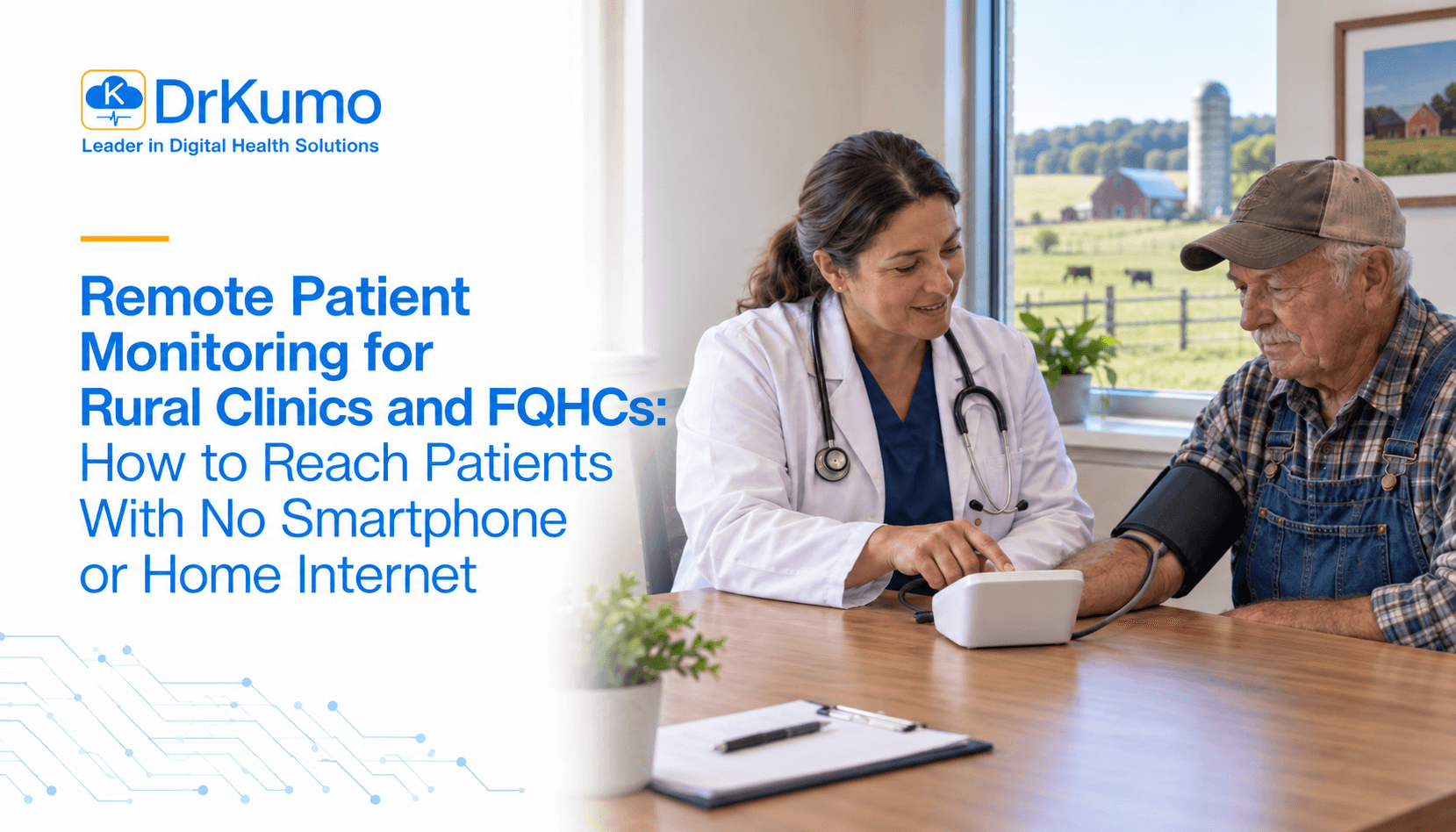
Rural clinics often have to follow patients with chronic conditions across long distances, with small teams, and with patients who have no smartphone or home internet. Remote Patient Monitoring (RPM) can still reach them. Medical devices that send readings over a cellular network let a patient take a measurement at home, while clinic staff review the data and follow up by phone.
This guide explains the rural health gaps that make monitoring hard, how cellular RPM works without WiFi or a phone app, what Medicare requires, which CPT codes apply, and how FQHCs and rural health clinics bill for these services. It also shows where DrKumo’s technology fits.
The short answer Yes. A clinic can use cellular connected medical devices that transmit readings on their own, so the patient needs no smartphone, no app, and no home internet. Staff review the data and call the patient. Two things to confirm first are cellular signal inside the patient’s home and the patient’s consent. CMS does not list a smartphone or home broadband among its RPM requirements. |
Why Rural Clinics Struggle to Follow Patients Between Visits
Between visits, a rural clinic often has little visibility into how a patient with a chronic condition is doing. Four gaps tend to combine, and each is familiar to rural health and FQHC organizations.
Gap 1 Distance Patients may live far from the clinic, so a visit just to check a blood pressure reading costs time and travel. | Gap 2 Small teams Limited staff capacity makes manual outreach calls and routine follow up hard to sustain. |
Gap 3 Chronic conditions Hypertension, diabetes, heart failure, and COPD benefit from regular readings that periodic visits cannot supply. | Gap 4 Connectivity Many patients have no smartphone or home internet, which rules out programs that depend on an app or home WiFi. |
How Common Is It for Rural Patients to Lack a Smartphone or Home Internet
87% Rural adults who own a smartphone | 78% Adults 65 and older who own a smartphone | 98% Adults who own a cellphone of some kind |
Source: Pew Research Center, Mobile Fact Sheet (2025 survey of U.S. adults).
Put another way, about one in eight rural adults has no smartphone, and more than one in five adults 65 and older has none, either. Since those are national figures, a clinic’s own panel may look different. Asking at enrollment is more reliable than assuming.
However, overall, since 98 percent of adults own a cellphone of some kind, a phone call is still the most widely available way to reach a patient.
How Cellular RPM Works Without WiFi or a Smartphone
A cellular RPM program replaces the home connection with a cellular one. The path has five steps, and none of them requires the patient to own a smartphone or hold a home internet subscription.
Step 1 | The patient takes a reading A blood pressure monitor, glucometer, weight scale, or similar medical device as defined by the FDA records the measurement. The patient does not open an app. |
Step 2 | The device sends the data over a cellular network Depending on the product, the device transmits on its own or through a small cellular hub in the home. Home WiFi is not part of the path. |
Step 3 | A secure platform receives the data CMS requires physiologic data to be collected electronically and uploaded automatically to a secure location where the billing practitioner can analyze it. |
Step 4 | Clinic staff review the data Staff review readings during clinic hours against the practitioner’s care plan. RPM is a monitoring service. Patients are not monitored around the clock, and RPM does not replace emergency care. |
Step 5 | The clinic contacts the patient by phone A real time phone conversation can meet the interactive communication standard for treatment management time, so video is not required. |
Key insight Coverage maps and real homes can disagree. The FCC National Broadband Map shows mobile coverage reported by carriers for outdoor and in vehicle use, not indoors. Test a reading inside the patient’s home during setup, before enrollment is complete. |
What Enrollment Can Look Like for a Patient with No Smartphone or Internet
The scenario below is illustrative. It does not describe a real patient or provide clinical advice, and every clinical decision stays with the treating practitioner.
Stage 1 | At the clinic The practitioner decides whether RPM fits a patient with a chronic condition, explains the program, and obtains consent. Staff record a preferred phone number and a caregiver contact. |
Stage 2 | At setup Staff confirm cellular signal inside the home, set up the device, and watch the patient take a first reading. |
Stage 3 | In the first weeks Readings transmit on their own. Staff review them during clinic hours and call the patient for the monthly conversation. |
Stage 4 | Ongoing If readings stop arriving, staff call to learn why, document the outreach, and update the plan with the practitioner. |
Connection Options for Patients Without Home Internet
Clinics have more than one way to move readings from a home without broadband. The right choice depends on the patient’s address, the devices in use, and who will help with setup.
| Approach | How the reading reaches the clinic | What the patient needs | What to watch for |
|---|---|---|---|
| Cellular connected device | The device has a built in cellular connection and sends each reading itself. | A power source and cellular signal where the device is used. | Signal strength indoors. Confirm before enrollment. |
| Cellular hub with standard devices | Devices send readings to a small hub in the home, and the hub transmits over a cellular connection. | Space and power for the hub, with devices kept near it. | Hub placement and patient help with setup. |
| Program provided hotspot | The clinic or a partner supplies a WiFi hotspot that the devices use to send data. | A power outlet and a signal source for the hotspot. | The hotspot still needs a working connection of its own. |
How FQHCs and Rural Health Clinics Can Use and Bill for RPM
Federally Qualified Health Centers (FQHCs) and Rural Health Clinics (RHCs) often serve communities where distance, staffing, and technology access are real constraints. For FQHCs and RHCs, the practical question is how to enroll patients who cannot use an app, and how those services are billed.
| Topic | What CMS says |
|---|---|
| Billing route | Since January 1, 2025, RHCs and FQHCs bill individual RPM codes instead of the older bundled code G0511, under CMS instructions. A transition period ran until at least July 1, 2025. |
| Payment basis | CMS pays the national non facility Physician Fee Schedule rate for these care coordination services, regardless of the charges. |
| Patient cost sharing | FQHC patients owe coinsurance. RHC patients owe a deductible and coinsurance. |
| Who can bill | Physicians and nonphysician practitioners eligible to provide evaluation and management services, per the CMS booklet. |
| Who can help | Auxiliary personnel can provide remote monitoring services under the general supervision of the billing practitioner. |
| Patient relationship | RPM requires an established patient relationship, which a health center’s primary care visits can supply. |
Explaining cost sharing at enrollment helps patients decide with full information, especially patients on fixed incomes. DrKumo describes how it supports health centers on its FQHCs and RHCs page.
What Medicare Requires and What the CMS Booklet Does Not List
The CMS Telehealth and Remote Monitoring booklet sets out what the device and the practice must do. It does not describe how the patient connects.
Listed as requirements
| Not listed in the booklet
|
Billing practitioners should confirm current requirements with their Medicare Administrative Contractor (MAC), because coverage details can change.
RPM CPT Codes for Setup, Device Supply, and Management
CMS describes remote monitoring in three components: patient education and device setup, device supply, and treatment management. Each has its own CPT codes. The table lists the codes most relevant to clinics enrolling patients with limited connectivity.
| CPT code | What it covers | Requirement | RHC and FQHC status |
|---|---|---|---|
| 99453 | Initial setup and patient education on using the equipment. | Patient education and device setup. | Listed as separately payable. |
| 99454 | Device supply with daily recordings or alerts, for 16 to 30 days in a 30 day period. | Data on 16 or more days. | Listed as separately payable. |
| 99445 | Device supply for 2 to 15 days in a 30 day period. New for 2026. | Data on 2 to 15 days. Not reported with 99454 for the same period. | Added after the 2025 instruction. Confirm with your MAC. |
| 99457 | Treatment management, first 20 minutes in a calendar month. | Interactive communication with the patient. | Listed as separately payable. |
| 99458 | Each additional 20 minutes of treatment management. | Interactive communication with the patient. | Listed as separately payable. |
| 99470 | Treatment management, first 10 minutes in a calendar month. New for 2026. | Interactive communication with the patient. | Added after the 2025 instruction. Confirm with your MAC. |
The 2025 CMS instruction lists 99453, 99454, 99457, and 99458 for RHCs and FQHCs. Noridian, a MAC, describes the 2026 codes 99445 and 99470, and notes that 99445 is not reported with 99454 in the same monitoring period. Confirm with your MAC which codes can be reported together and how the 2026 codes apply to health centers.
For a rural patient whose signal drops during the month, the lower two to 15 day threshold changes how a short month of data is reported. Billing decisions remain with the practice and its billing practitioners.
Treatment management also requires interactive communication with the patient. CMS has described that at a minimum, there must be a real time, two way audio conversation. A standard phone call meets that requirement, and video is not needed. Confirm the current definition with your MAC.
Clinics that rely on contracted clinical partners should also watch the CY 2027 proposal to require employed RPM staff, which Senators Warner and Blackburn asked CMS to reconsider. DrKumo covers it in an article on the senators’ letter. The proposal is not final.
Where State Funding Fits for Rural Clinics and Health Centers
CMS’s Rural Health Transformation Program is distributing $50 billion to states from fiscal year 2026 through 2030. CMS has said state investments will expand telehealth, remote patient monitoring, and digital tools. Clinics and health centers can ask their state health agency how their state plans to use those funds.
How DrKumo Supports RPM Programs in Rural Communities
DrKumo provides secure, HIPAA compliant digital health technology that supports remote patient monitoring programs operated by healthcare providers. The platform moves physiologic data from patients’ homes to care teams over cellular connectivity, with no WiFi or smartphone app required, using medical devices as defined by the FDA. For rural health organizations, FQHCs and RHCs, and community providers, that design speaks to the connectivity gap described above.
| Clinic need | How DrKumo’s approach fits |
|---|---|
| Patients without a smartphone | No smartphone app is required for the patient. |
| Homes without WiFi | Data travels from the home to the care team over cellular connectivity. |
| Patient data security | Technology that is HIPAA compliant and FIPS compliant, with healthcare cybersecurity practices applied to patient data. |
| Consistent care pathways | DrKumo supports provider led Disease Management Protocols for hypertension, diabetes, heart failure, and COPD. |
| FQHC and RHC programs | DrKumo supports RPM programs at FQHCs and RHCs and describes a monthly billing report to support claim preparation. Coding and billing decisions stay with the provider. |
Coverage still varies by address, so clinics should verify a reliable signal at each patient’s home before enrollment. Practices can review DrKumo’s comprehensive guide to RPM for program structure. DrKumo is a technology provider and is not a clinical entity. Providers retain full clinical responsibility for patient care decisions, and RPM supports monitoring between visits rather than replacing emergency care.
An Onboarding Checklist for Patients with Limited Connectivity
Use this checklist before and during enrollment. It focuses on the steps that matter most when a patient has no smartphone or home internet.
Onboarding checklist
|
Key Takeaways
Rural clinics can monitor patients without a smartphone or home internet by using medical devices that transmit readings over a cellular network. Clinic staff then review the data and reach the patient by phone.
CMS describes RPM requirements in terms of what the device does: collect physiologic data electronically and upload it automatically to a secure location. The CMS booklet does not list a smartphone or home broadband. For 2026, CMS added CPT 99445 and CPT 99470, which cover 2 to 15 days of data and the first 10 minutes of management. RHCs and FQHCs bill the individual RPM codes.
Connectivity varies by address, so check signal inside the patient’s home, document consent, and plan how staff will reach patients who stop transmitting. DrKumo is a technology provider and is not a clinical entity, and RPM does not replace emergency care.
Data driven care starts here Bring remote monitoring to patients beyond the reach of home internet. To learn how DrKumo can help your organization deliver secure, HIPAA compliant remote patient monitoring to rural patients, contact us today. Our team is ready to support your journey toward better patient care.
|
Frequently Asked Questions About RPM for Rural Patients Without a Smartphone
Questions rural clinics ask about monitoring patients who have limited technology at home.
Can remote patient monitoring work for patients with no smartphone or home internet?
Yes, when the program uses medical devices that transmit readings over a cellular network instead of home WiFi or a phone app. The patient takes the reading, the device sends it, and clinic staff review the data and call the patient. Cellular signal at the patient’s address still needs to be confirmed.
Does Medicare require a smartphone or WiFi for RPM?
The CMS Telehealth and Remote Monitoring booklet does not list either as a requirement. It requires that physiologic data be collected electronically and uploaded automatically to a secure location, using a device that meets the FDA definition of a medical device. Confirm current requirements with your MAC.
Which CPT codes apply to RPM, and what changed in 2026?
RPM uses CPT 99453 for setup and patient education, 99454 for device supply with 16 or more days of data, and 99457 and 99458 for treatment management in 20 minute increments. For 2026, CMS added 99445 for device supply with 2 to 15 days of data and 99470 for the first 10 minutes of treatment management. Confirm combination rules and how the 2026 codes apply to health centers with your MAC.
Can FQHCs and rural health clinics bill Medicare for RPM?
Yes. Under CMS instructions effective January 1, 2025, RHCs and FQHCs bill RPM codes 99453, 99454, 99457, and 99458 individually as care coordination services at the national non facility Physician Fee Schedule rate, instead of the older bundled code G0511. FQHC patients owe coinsurance, and RHC patients owe a deductible and coinsurance. Confirm details, including the 2026 codes, with your MAC.
How does remote patient monitoring help rural patients with chronic conditions?
RPM gives a rural clinic readings between visits, which reduces the need for a patient to travel only to have a measurement taken and helps staff notice when readings change. The treating practitioner decides what to do with the data. RPM is monitoring only and does not replace emergency care.
References
Centers for Medicare & Medicaid Services. (2025). Telehealth & Remote Monitoring (MLN901705). CMS.gov.
Centers for Medicare & Medicaid Services. (2024). Updates to Billing for Care Coordination Services for Rural Health Clinics and Federally Qualified Health Centers (Transmittal 12958). HHS.gov.
Centers for Medicare & Medicaid Services. Rural Health Transformation Program. CMS.gov.
Noridian Healthcare Solutions. (2025). Remote Physiologic Monitoring (RPM): 2026 Evaluation and Management (E/M) Updates. Medicare Administrative Contractor, Jurisdiction F Part B.
Federal Communications Commission. How to Use the FCC’s National Broadband Map. FCC.gov.
Association of American Medical Colleges. (2021). 2021 Medicare Coverage of Remote Physiologic Monitoring (RPM). AAMC.org.
Pew Research Center. (2025). Mobile Fact Sheet. PewResearch.org.
Disclaimer: This article is intended for informational purposes only and does not constitute medical, legal, billing, or financial advice. Medicare coverage, coding, and payment requirements are subject to change, and connectivity and coverage vary by location and carrier. Always consult official CMS sources and your Medicare Administrative Contractor for current requirements. DrKumo is a technology provider and is not a clinical entity. It does not provide clinical services or replace a licensed provider’s clinical judgment. Always consult with a licensed healthcare provider for guidance on diagnosis, treatment, or medical decisions. References to CMS, HHS, the FCC, and other agencies do not constitute or imply an endorsement by those agencies or the U.S. Government. |